- Views: 2K
- Replies: 1
The Boeing MQ-28 Ghost Bat, an advanced unmanned combat aerial vehicle (UCAV) developed in Australia, is increasingly being seen as a strong contender to fulfill the future requirements of the Indian Air Force (IAF).
As strategic defence partnerships between New Delhi and Canberra broaden to include cutting-edge aerospace technology, the MQ-28 is drawing significant attention.
Although no formal purchase agreement has been declared by either government, recent engagements suggest that talks about this state-of-the-art "loyal wingman" drone are moving forward.
This growing interest became highly visible during the 12th Air Staff Talks held in Canberra in May 2026.
Following discussions on future aerospace collaboration, the Australian Department of Defence shared a notable image featuring IAF Air Vice-Marshal Sanjeev Taliyan alongside Australian Deputy Chief of Air Force Air Vice-Marshal Steven Pesce, with an MQ-28 Ghost Bat demonstrator prominently displayed in the background.
While the release stopped short of explicitly confirming procurement negotiations, defence analysts widely interpreted the photo as a calculated message that the Ghost Bat is a key part of their ongoing collaborative technology assessments.
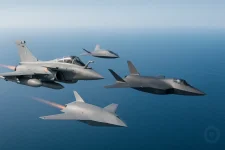
Built by Boeing Australia, the Ghost Bat serves as a Collaborative Combat Aircraft (CCA) engineered to fly in tandem with crewed fighter jets.
Unlike standard remotely piloted drones, this platform uses advanced artificial intelligence to act autonomously. It can take on high-risk missions—such as electronic warfare, intelligence gathering, acting as a decoy, and conducting precision strikes—keeping human pilots safely out of harm's way.
The aircraft's maturity has been firmly established in recent months; by mid-2026, the program had logged over 150 test flights, successfully conducted air-to-air live-fire engagements, and formally validated its stealth capabilities through rigorous radar cross-section testing.
According to defence industry insiders, Boeing is willing to present the MQ-28 to India with a robust package of technology transfer (ToT).
This proposal would likely involve domestic manufacturing and deep system customization to meet the IAF's specific needs.
Such an agreement could seamlessly link the Ghost Bat with India's current fleet, allowing it to fly alongside the homegrown Tejas Mk1A, the French-origin Rafale, and the Su-30MKI.
By tailoring communication systems and mission software, Indian pilots could effectively command these autonomous wingmen directly from their cockpits.
The IAF's push toward collaborative combat drones is heavily influenced by the rapidly changing security landscape and emerging aerial threats in the region.
The proliferation of next-generation, AI-driven combat drones—such as Türkiye’s Bayraktar Kızılelma—highlights a global shift where the boundaries between traditional manned fighters and unmanned combat vehicles are actively disappearing.
To maintain air superiority and technological parity with neighbouring forces, the IAF recognizes the urgent need to integrate these autonomous systems into its combat squadrons.
India is concurrently investing in its own domestic drone programs to secure long-term self-reliance.
Key projects include the Defence Research and Development Organisation’s (DRDO) Ghatak stealth UCAV and Hindustan Aeronautics Limited’s (HAL) CATS Warrior, the latter of which is anticipated to make its maiden flight by 2027.
However, because these indigenous platforms are still in the development and testing phases, they are not expected to enter operational service in the immediate future.
Given this timeline, the MQ-28 Ghost Bat presents a strategic opportunity for the IAF to fast-track its modernization.
The aircraft recently proved its global deployability by conducting its first international test flights in California, proving it is a mature, field-tested asset.
By acquiring an established loyal wingman while domestic projects continue to evolve, the IAF could immediately begin gaining crucial operational experience in complex manned-unmanned teaming, artificial intelligence mission control, and distributed air combat strategies.