- Views: 4K
- Replies: 14
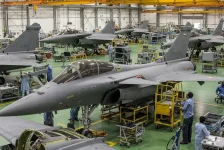
The potential acquisition of 114 Multi-Role Fighter Aircraft (MRFA), widely speculated to be an expansion of the Dassault Rafale fleet, has ignited intense discussion within India’s strategic community.
With an estimated price tag of $36 billion (roughly ₹3 lakh crore), critics argue that such a massive foreign purchase could drain the Indian Air Force’s (IAF) capital budget, effectively choking the funding for home-grown projects like the Tejas Mk2 and the fifth-generation Advanced Medium Combat Aircraft (AMCA).
However, a detailed analysis of the IAF’s projected capital expenditure (CAPEX) suggests these concerns may be unfounded.
When structured correctly, the Rafale deal does not necessarily compete with indigenous development; instead, it may secure the financial and operational stability required for Indian platforms to mature.
The Fiscal Reality: A Manageable Commitment
The core of the anxiety lies in the sheer size of the $36 billion figure. Yet, defence procurement is rarely paid upfront.Looking ahead to the 2026–27 financial year and beyond, the IAF’s annual capital budget—used for buying new hardware—is projected to stabilise between $9 billion and $10 billion annually.
This steady state accounts for a modernisation cycle where the force is simultaneously acquiring helicopters, missiles, radars, and aircraft.
In this context, the affordability of the Rafale depends entirely on the payment schedule:
- The 10-Year Model: If the deal is spread over a decade, annual payments would average $3.6 billion. This would consume about 35–40% of the Air Force's capital budget. While heavy, it still leaves roughly $5.5–6 billion annually for other needs.
- The 15-Year Model: A more prudent approach, extending payments over 15 years, would reduce the annual burden to approximately $2.4 billion. This would absorb just over a quarter (25–28%) of the budget, leaving a healthy $6.5–7.5 billion every year for parallel acquisitions.
Protecting the Indigenous Pipeline
Contrary to the fear that a foreign deal would starve local industry, the "residual" budget—the money left after paying for the Rafales—remains substantial.India’s key domestic aviation projects have specific funding peaks that fit within this remaining envelope:
- Tejas Mk1A: The production of 97 of these indigenous fighters is expected to require peak funding of $1.1–1.2 billion annually.
- Prachand LCH: The induction of 156 Light Combat Helicopters will likely cost around $1.3 billion per year.
- Missile Systems: The manufacturing ramp-up for the Astra Mk2 and Mk3 air-to-air missiles is estimated to need $1 billion annually, with the Rudram series of anti-radiation missiles costing significantly less in its early stages.
This financial headroom is critical. It is this surplus that will fund the research and development (R&D) for the future: the Tejas Mk2, the AMCA, new drone fleets, and airborne warning systems (AWACS).
Timing is Everything
The strategic value of a long-term payment plan extends beyond mere affordability; it aligns with the development timelines of India's next-generation fighters.Open-source reports indicate that the Tejas Mk2 is targeting a rollout in late 2025 or early 2026, with its most capital-intensive testing phase occurring in the latter half of this decade.
Similarly, the AMCA project, which recently received Cabinet Committee on Security (CCS) approval for prototype development, will require sustained heavy funding throughout the 2030s.
A front-loaded payment for foreign jets would disastrously clash with these indigenous needs.
However, a staggered 15-year structure prevents this collision. It ensures that the Rafale payments are spread thin, keeping the "fiscal oxygen" available for the Tejas Mk2 and AMCA exactly when they need it most.
A Bridge, Not a Barrier
Beyond the ledger sheets, the operational reality of the IAF makes the Rafale essential.The force’s fighter strength has dipped to approximately 29–31 squadrons, well below the sanctioned strength of 42. This decline is driven by the rapid retirement of the MiG-21 Bisons—slated to phase out completely by 2025—and the upcoming drawdown of the Jaguar and older MiG-29 fleets.
In this scenario, the Rafale is not a luxury; it is a force-restoration necessity. Indigenous production lines, while growing, cannot currently churn out aircraft fast enough to plug this widening gap alone.
The Rafale acts as a "bridge," ensuring India maintains a credible deterrence and combat edge while the Tejas Mk2 moves from prototype to mass production.
Furthermore, since India has already invested in Rafale-specific infrastructure (maintenance bays, simulators) for its existing fleet, inducting more units would be faster and cheaper than introducing a completely new aircraft type.
Conclusion
The financial arithmetic points to a clear conclusion: a $36 billion Rafale deal is not a budget-breaker, provided it is managed with a long-term horizon.By opting for a 15-year payment structure, the Ministry of Defence can ensure the IAF remains combat-capable today without compromising the sovereignty of tomorrow.
Far from killing the indigenous dream, the Rafale deal effectively underwrites it, buying the vital time and security needed for the Tejas Mk2 and AMCA to succeed.