- Views: 2K
- Replies: 3
The Indian Navy’s quest for a home-grown deck-based fighter is arriving at its most critical juncture.
The Twin Engine Deck Based Fighter (TEDBF) programme, an ambitious initiative to develop a carrier-borne combat aircraft, is slated to undergo its Critical Design Review (CDR) this year.
This phase marks the vital shift from theoretical design to detailed engineering.
However, for the Indian defence ecosystem, this is more than a technical procedure; it is a strategic crossroads that will determine if India truly commits to indigenous naval aviation or reverts to long-term foreign dependency.
A "Rafale Killer" in the Making?
Spearheaded by the Aeronautical Development Agency (ADA), the TEDBF is frequently—and perhaps provocatively—dubbed a "Rafale killer" within naval circles.The moniker underlines the aircraft's intended role: a robust, multi-role fighter capable of operating from India's current STOBAR (Short Take-Off But Arrested Recovery) carriers, like the INS Vikrant, and future CATOBAR platforms.
However, ambition comes with a steep price tag. The development cost for the TEDBF is estimated to be approximately ₹15,000 crore.
Industry experts note that this figure is nearing the capital requirements of the fifth-generation Advanced Medium Combat Aircraft (AMCA) programme. The high cost is driven by the necessity of integrating cutting-edge technologies.
While the TEDBF is not a "stealth" fighter in the strictest definition, it is expected to feature a low-observability profile, canard-delta wings, and advanced avionics comparable to 4.5++ generation global standards.
It will likely share a propulsion system with the AMCA, utilizing high-thrust GE F414 engines, alongside next-generation sensor fusion and electronic warfare suites.
The Rafale Temptation
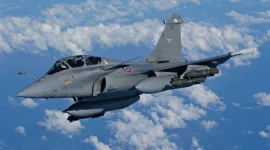
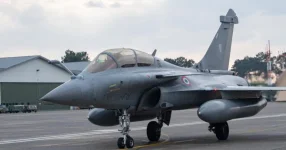
The friction point for the TEDBF lies in the parallel procurement realities of the Indian Armed Forces. The Indian Navy has already moved to acquire 26 Dassault Rafale M fighters to plug immediate operational gaps.Simultaneously, the Indian Air Force (IAF) is negotiating a massive acquisition of 114 fighters, with the land-based Rafale being a frontrunner under a "Make in India" framework.
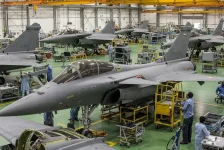
This creates a compelling bureaucratic logic: if India is already setting up supply chains and maintenance hubs for the Rafale, why not simply order more Rafale M jets for the Navy instead of sinking ₹15,000 crore into a new development programme?
On the surface, this approach offers logistical commonality and a proven, combat-tested platform.
The High Cost of Imports
However, the argument for efficiency ignores the massive long-term financial capability drain.Expanding the Rafale M order to meet the Navy’s full requirement of nearly 100 aircraft would require an estimated capital outlay exceeding $25 billion over the coming decades.
Such an expenditure would severely constrict India’s defence capital budget, leaving little room for domestic Research and Development (R&D).
Furthermore, relying on imports locks the Navy into a cycle of foreign dependency for upgrades and weapon integration.
In contrast, the TEDBF offers the potential for true strategic autonomy, allowing Indian industry to retain intellectual property and climb the aerospace value chain—from flight control laws to composite manufacturing.
The IAF as a Saviour?
Strategic analysts argue that the survival of the TEDBF may hinge on the Indian Air Force.If the IAF adopts the TEDBF as a viable option—potentially inducting two to three squadrons to complement its future fleet—the programme's economies of scale would shift drastically.
A shared ecosystem between the IAF and Navy for a twin-engine 4.5++ generation fighter would harmonize maintenance, engine inventories, and avionics upgrades.
This would position the TEDBF not merely as a niche naval project, but as a central pillar of India's combat aviation future, bridging the gap between the Tejas Mk2 and the stealth AMCA.
The Engineering Challenge
Developing a carrier-based fighter is an unforgiving engineering challenge. Unlike land-based jets, a naval fighter must withstand the immense structural loads of arrested landings and ski-jump launches.It requires reinforced landing gear, strengthened fuselage sections, and resistance to harsh saltwater corrosion. The TEDBF aims to meet these demands while delivering a payload and range superior to the current MiG-29K fleet.
The upcoming Critical Design Review will test whether Indian engineers have successfully solved these complex aerodynamic and structural equations.
Conclusion
Ultimately, the choice facing the Ministry of Defence is not just about affordability in the current fiscal year. It is a decision between the convenience of immediate imports and the difficult, yet rewarding, path of self-reliance.If the TEDBF is sidelined now in favour of an expanded Rafale M fleet, India risks sacrificing its long-term aerospace ambitions. The CDR in 2026 will test the technology; the funding decisions that follow will test the nation's resolve.