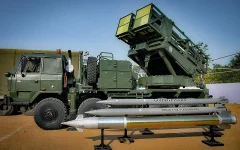
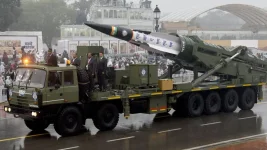
India's Defence Research and Development Organisation (DRDO) is fast-tracking the creation of the Pinaka Mk4, an advanced guided rocket that will boost the Indian Army's precision strike range to 300 kilometres.
This extended-range weapon is set to be a cornerstone of the country's upcoming Integrated Rocket Force, offering the ability to hit critical targets far beyond the capacity of current Pinaka models.
Based on insights from project insiders, the initial pre-production units of the Pinaka Mk4 are slated for completion by 2028.
At this point, the system will undergo rigorous developmental and user trials. Assuming these tests are successful, the DRDO hopes to receive the green light for mass manufacturing by 2030, which will eventually lead to its formal integration into the Indian Army's arsenal.
The Mk4 is the most significant upgrade in the history of India's homegrown multi-barrel rocket launcher (MBRL) series.
Previous versions successfully increased the rocket's reach from the original 37.5 to 40 kilometres to 75 kilometres, and most recently up to 120 kilometres using guided technology.
In contrast, the Mk4 variant elevates the Pinaka into a formidable long-range precision asset, designed to destroy strategic assets at distances typically handled only by tactical ballistic missiles.
By achieving a 300-kilometre range, the Pinaka Mk4 will effectively close the tactical gap that exists between standard artillery rockets and short-range ballistic missiles.
Engineers are designing this weapon to execute pinpoint strikes on vital enemy infrastructure, such as command headquarters, supply depots, air defence installations, and large troop formations located deep within adversarial borders.
This development is a crucial piece of India's larger strategy to build an Integrated Rocket Force, equipping the military with versatile, multi-layered firepower.
This vision aims to merge various domestically produced precision strike platforms—such as the extended-range Pinaka variants and the Pralay quasi-ballistic missile—into a cohesive network. Such a unified system will allow the armed forces to swiftly neutralise threats at multiple distances simultaneously.
Moving away from conventional unguided munitions, the Mk4 will feature state-of-the-art inertial navigation and terminal guidance systems. This upgrade ensures superior accuracy without sacrificing the rapid, high-volume fire that rocket artillery is known for.
With such precision, military commanders can destroy key targets using fewer rockets, thereby saving ammunition and enhancing overall combat efficiency.
The current roadmap shows that the project is successfully moving through essential design phases and component testing, setting the stage for the 2028 pre-production milestone.
These initial rockets will be subjected to exhaustive tests to confirm their propulsion, flight stability, guidance accuracy, and overall reliability in real-world combat scenarios.
Once these rigorous evaluations are cleared, the DRDO will push for serial production by 2030 to officially equip the forces.
Defence analysts frequently compare the Pinaka Mk4 to the American Army Tactical Missile System (ATACMS) due to its comparable role as a deep-strike precision weapon.
However, rather than being a standalone ballistic missile, the Mk4 is an extension of the existing Pinaka family.
This commonality is a major advantage, as it allows the Army to utilise its current launch platforms, logistics, and support networks without requiring entirely new infrastructure, while still delivering devastating firepower in a matter of seconds.
The pursuit of a 300-kilometre weapon perfectly aligns with the DRDO's recent successes with other Pinaka models, most notably the 120-kilometre Long Range Guided Rocket (LRGR).
Recent flight tests in July 2026 validated the 120-km variant's ability to strike targets with "textbook precision" across its full operational envelope, and reports suggest DRDO is even conceptualising a 450-kilometre version.
Together, these systems give the Army a comprehensive suite of domestic precision weapons for various tactical depths.
Upon its final induction, the Pinaka Mk4 will dramatically upgrade the Indian Army's stand-off capabilities, allowing for the precise destruction of enemy assets from safe distances while cutting reliance on foreign weapon systems like the ageing Russian Smerch fleet.
By joining India's growing arsenal of missiles and artillery, this new variant will solidify the nation's readiness for modern, network-centric warfare across multiple domains.