- Views: 2K
- Replies: 4
The Zorawar Light Tank project is swiftly transitioning from a single armoured vehicle into a comprehensive family of tracked combat platforms.
Tailored specifically for the Line of Actual Control (LAC), this ecosystem aims to become the Indian Army's primary modular solution for high-altitude operations.
Led by the Defence Research and Development Organisation (DRDO) and Larsen & Toubro (L&T), the development has progressed at an impressive speed.
This is largely due to a fresh, highly adaptable design strategy that relies on a single tracked base engineered to withstand the severe conditions of the Himalayas.
Older armoured vehicle fleets often rely on distinct machines that demand separate logistical and maintenance chains. In contrast, the Zorawar program is built on a universal high-mobility foundation that can be adapted into various combat and support roles, all while sharing core automotive components.
The heart of this system is the specialized chassis itself. Weighing approximately 25 tonnes and powered by a robust 760-horsepower engine, it boasts an excellent power-to-weight ratio, amphibious capabilities, and an advanced hydropneumatic suspension.
These features ensure the tank can maneuver easily above 15,000 feet, an elevation where traditional heavy tanks lose power due to the thin air and steep slopes.
Indian defence strategists see this adaptability as essential for easing the heavy logistical burden in mountainous regions.
By using the same engines and mobility parts across different vehicle types, the army can vastly simplify its supply lines, repair processes, and overall battlefield maintenance on the frontlines.
While the standard light tank is still undergoing extensive field trials ahead of its projected 2028–2029 induction to meet an initial requirement of 354 units, it is already serving as the blueprint for new, specialized versions through interchangeable combat modules.
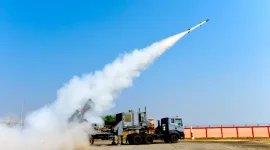
One major configuration currently being tested is the addition of twin indigenous Nag Mk2 anti-tank guided missile launchers to the vehicle's Belgian-designed 105mm John Cockerill turret.
Successfully test-fired recently, this upgrade turns the tank into a dual-threat system, allowing it to strike enemy armour from the top at distances between 7 and 10 kilometres.
This missile integration grants the vehicle the ability to hit targets it cannot see directly, all without losing the firepower of its main 105mm gun. This mirrors a growing global military trend of blending traditional cannons with long-range missiles to overwhelm heavily protected opponents.
Another concept under exploration involves equipping the turret with pods that can launch micro-drones or loitering munitions. This addition would give armoured units their own built-in tools for scouting and precise strikes, which is vital in mountainous landscapes where physical obstacles block direct vision.
With these integrated drones, tank crews could perform sophisticated search-and-destroy missions. They could fly munitions over hills and ridges to spot and attack hidden targets long before coming into direct firing range.
Moving beyond ground combat, the Indian Army is exploring a Self-Propelled Air Defence Gun (SPAD-G) variant built on the same Zorawar base.
This need has become critical as modern mountain warfare is increasingly threatened by attack helicopters, drone swarms, and low-flying cruise missiles. Current heavy air-defence vehicles struggle to operate at these altitudes due to engine overheating and poor mobility.
To counter these aerial threats, the SPAD-G model would swap the main 105mm cannon for a dedicated air-defence module. This setup would likely feature rapid-firing twin 30mm or 35mm automatic cannons paired with short-range surface-to-air missiles.
Thanks to the vehicle's exceptional power-to-weight ratio—estimated between 30 and 40 horsepower per tonne—and low ground pressure, this air-defence variant could easily keep pace with fast-moving columns, offering vital protection in narrow mountain passes and soft terrain.
Another strategically important version on the drawing board is a command and reconnaissance vehicle, designed specifically to improve battlefield coordination across the challenging terrains of Ladakh and Sikkim.
This specialized model would trade heavy weapons for advanced technology, including a telescoping surveillance mast, battlefield radars, satellite communications, and built-in controls for local drone operations.
Such a platform would significantly boost real-time awareness for commanders, overcoming the communication blackouts and line-of-sight issues frequently caused by steep mountain ranges.
This command variant is also expected to carry electronic warfare tools and anti-drone defence mechanisms. These jammers and interceptors would protect mobile armoured units from enemy surveillance and aerial attacks.
Furthermore, the chassis could be modified into a high-altitude troop carrier. Armed with a remote-controlled 30mm weapon station, this version could transport six to eight soldiers rapidly across rivers and mountains where wheeled vehicles often get stuck.
Ultimately, the true value of the Zorawar program lies in its streamlined logistics. Rather than juggling different maintenance processes for various machines, the Indian Army can support multiple battlefield roles with one standardized vehicle family.
This unified approach cuts down on training time, reduces the need to stockpile diverse spare parts, and simplifies repair facilities, thereby ensuring a more flexible and responsive military presence along the LAC.