India’s regional aviation landscape is poised for a significant transformation following a strategic announcement by Hindustan Aeronautics Limited (HAL) and Russia’s United Aircraft Corporation (UAC).
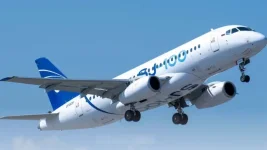
In a move to bolster domestic civil aviation capabilities, the two entities have formalised a plan to introduce the SJ-100 Superjet to the Indian market.
The initiative will commence with the import of fully assembled aircraft for testing, eventually leading to the assembly of semi-knocked-down (SKD) kits within India.
According to sources close to the development, the local assembly of the SJ-100 is projected to begin within the next three years. This phased timeline is designed to allow Indian manufacturing facilities to progressively acquire the necessary technical expertise.
It ensures that aircraft can be introduced to the market without the delay associated with setting up a fully localised production line immediately.
For HAL, an organisation that has historically concentrated on defence aerospace, this collaborative project marks a pivotal expansion into civil aircraft assembly, leveraging a proven foreign design.
Prior to any long-term commitment from Indian carriers, the SJ-100 will be made available on short-term leases for comprehensive evaluation.
This strategy aims to provide domestic airlines with a hands-on opportunity to analyse the jet’s operational efficiency, economic viability, and adaptability to India’s diverse regional routes.
Instead of depending solely on theoretical data or flight simulators, operators will be able to test the aircraft in genuine Indian conditions, ranging from high-altitude airports to high-density regional networks.
To facilitate this assessment phase, UAC intends to lease a batch of 10 to 20 SJ-100 airframes directly from Russia for initial operations.
These operational units will enable potential Indian customers to gain critical experience, train flight and ground crews, and understand the specific maintenance and support ecosystems required for the fleet.
Industry experts believe this "try-before-you-buy" model will significantly lower the entry risk for airlines, fostering confidence in the new aircraft type.
The SJ-100 is a modernised iteration of the Superjet family, distinguished by a high percentage of indigenous Russian components, including the new PD-8 turbofan engines.
With a seating capacity of approximately 103 passengers and a range of around 3,500 to 4,500 kilometres, it is positioned to bridge the market gap between smaller turboprops and larger narrow-body jets.
This makes it particularly suitable for connecting Tier-2 and Tier-3 cities under India’s regional connectivity schemes, such as UDAN.
Should the leasing phase yield positive feedback from operators, the partnership plans to transition to full-scale assembly in India.
This progression would likely spur the creation of a comprehensive support ecosystem, including domestic suppliers, maintenance, repair, and overhaul (MRO) providers, and training centres.
For India, successful implementation would not only diversify its commercial aviation portfolio but also enhance national competencies in civil aviation production standards, certification, and lifecycle management.
While the precise commercial terms and delivery schedules are being finalised, the roadmap—combining early leasing, incremental localisation, and joint production—indicates a prudent yet ambitious strategy.
For Indian operators, the immediate future offers a tangible preview of the SJ-100’s potential as a regional workhorse.
For the nation’s aerospace sector, it signifies a decisive stride towards establishing a balanced industrial base that serves both civil and defence requirements.