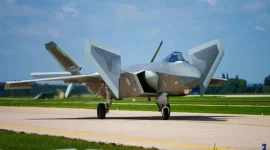
Hindustan Aeronautics Limited (HAL) is approaching a crucial milestone in the development of the Hindustan Lead-in Fighter Trainer-42 (HLFT-42).
According to company insiders, the immediate priority is finalizing the engine selection for the new aircraft.
Sources indicate that once the engine specifications are officially locked in, the overall airframe can be tailored around it, ensuring the design phase is successfully concluded before 2030.
This development reflects steady progress for the supersonic jet, which is designed to serve a dual purpose.
The Indian Air Force (IAF) strongly supports the project, viewing the platform as an essential stepping stone that connects basic pilot training with complex combat flying.
Additionally, the HLFT-42 is widely expected to eventually replace the IAF's ageing fleet of BAE Hawk 132 advanced jet trainers.
The HLFT-42 was initially showcased to the public as a concept during the Aero India 2023 exhibition.
It was conceptualised to directly address the IAF's requirement for a state-of-the-art Lead-in Fighter Trainer (LIFT) that also possesses genuine combat capabilities.
At that time, HAL representatives confirmed that the Air Force had given its backing to the development of this versatile trainer-cum-fighter.
Open-source data indicates that the aircraft will have a Maximum Take-Off Weight (MTOW) of roughly 16.5 tonnes, making it only slightly lighter than the upcoming Tejas Mk2 fighter jet.
The primary objective of the HLFT-42 is to prepare budding aviators to fly advanced platforms like the Tejas Mk2 and the fifth-generation Advanced Medium Combat Aircraft (AMCA).
To provide a realistic training environment, the jet will be equipped with modern features such as fly-by-wire flight controls, an Active Electronically Scanned Array (AESA) radar, an Electronic Warfare (EW) suite, and an Infrared Search and Track (IRST) system.
Updated models displayed at Aero India 2025 demonstrated its impressive ability to carry a wide array of weapons across 11 hardpoints.
The aircraft is planned to be compatible with advanced munitions like the Astra and ASRAAM air-to-air missiles, as well as precision-guided bombs.
This formidable arsenal allows the trainer to effectively double as a highly capable and cost-efficient light combat aircraft in real-world scenarios.
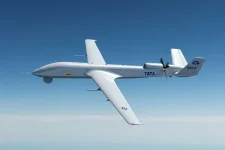
Notably, HAL is also positioning the aircraft as a potential command mothership for its CATS (Combat Air Teaming System) unmanned drone network.
The ultimate success of the program currently depends on the engine choice.
Discussions regarding the powerplant began as early as 2021. Initially, HAL evaluated several options, including the Russian AL-31F engine used in the Su-30MKI, and the American GE F414 engine, which has already been selected for the Tejas Mk2.
Both engines offered strong performance and proven reliability. However, recent indicators suggest a preference for an engine similar to the F414, which produces 98 kN of thrust.
This aligns closely with a formal Request for Information (RFI) issued by HAL in March 2025, which sought a military turbofan engine delivering between 95 and 100 kN of thrust and boasting a technical lifespan of over 6,000 hours.
Defence experts suggest that if the Transfer of Technology (ToT) agreement for the GE F414 engine is successfully finalized, it would greatly enhance India's domestic manufacturing capabilities.
Should this occur, the GE powerplant could be integrated into the HLFT-42 prototypes expected after 2030, as well as the final production models.
Utilizing the same engine across both the Tejas and HLFT-42 fleets would ensure significant logistical commonality, ultimately lowering maintenance and operational costs over the aircraft's lifespan.
Despite this trajectory, HAL is maintaining a flexible approach.
There is still a possibility of upgrading the aircraft to use the more powerful 120 kN-class engine that is currently being co-developed with French firm Safran for the AMCA project.
This decision will largely depend on comparative costs and the specific operational priorities of the IAF.
According to HAL officials, the final choice will be dictated by whether the Air Force desires a strictly dedicated trainer or a platform that can seamlessly transition into a frontline combat asset.
Such adaptability means the HLFT-42 could easily evolve from an advanced trainer into a light combat fighter capable of undertaking independent strike missions.
Throughout this process, HAL and the IAF are placing a strong emphasis on the reliability and availability of the chosen engine.
Learning from previous challenges encountered during the development of the HJT-36 Sitara, HAL is utilizing modern techniques, including 3D scanning of historic aircraft like the HF-24 Marut, to ensure a highly stable aerodynamic design.
Furthermore, the Indian Navy has shown interest in a modified version of the HLFT-42 for training its aircraft carrier pilots, a move that could promote greater synergy between the armed forces.
To prevent schedule overruns and expedite the initial development phases, HAL has proactively allocated up to ₹1,000 crore from its own internal funds.
This financial commitment bypasses the lengthy wait for formal government approvals and strongly supports the nation's broader push for self-reliance in the defence manufacturing sector.