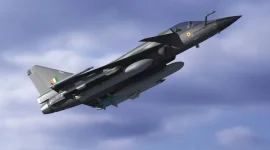
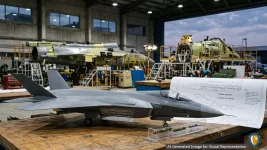
Hindustan Aeronautics Limited (HAL) is nearing a major turning point in the creation of the Hindustan Lead-in Fighter Trainer-42 (HLFT-42).
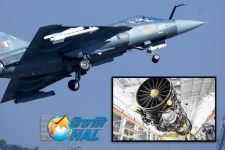
According to sources within the company, the top priority right now is selecting the right engine for the upcoming aircraft.
Once the engine parameters are formally confirmed, the entire airframe can be structured around it. This step is necessary to ensure the design stage wraps up smoothly before the year 2030.
These updates highlight the consistent progress being made on the supersonic jet, which is being engineered for two distinct roles.
The project enjoys strong backing from the Indian Air Force (IAF), which sees the aircraft as a vital link between basic flight training and advanced combat operations.
Furthermore, it is widely anticipated that the HLFT-42 will eventually take the place of the IAF's older fleet of subsonic BAE Hawk 132 advanced jet trainers.
The HLFT-42 first caught the public's attention when its concept scale model was unveiled at the Aero India 2023 exhibition in Bengaluru.
It was specifically envisioned to meet the IAF's demand for a modern Lead-in Fighter Trainer (LIFT) that is also equipped with genuine combat capabilities.
During that initial showcase, HAL officials noted that the Air Force fully supported the creation of this flexible trainer and fighter jet.
Publicly available specifications show that the aircraft will feature a Maximum Take-Off Weight (MTOW) of approximately 16.5 tonnes. This makes it just slightly lighter than the forthcoming Tejas Mk2 fighter.
It is also expected to carry an internal fuel capacity of around 3,500 kg and achieve maximum speeds of up to Mach 1.8.
The main goal of the HLFT-42 is to train new pilots to handle next-generation aircraft, including the Tejas Mk2 and the fifth-generation Advanced Medium Combat Aircraft (AMCA).
To create a lifelike combat training experience, the aircraft will feature cutting-edge systems. These include fly-by-wire flight controls, an Active Electronically Scanned Array (AESA) radar, an Infrared Search and Track (IRST) sensor, and a comprehensive Electronic Warfare (EW) suite.
When updated mockups were presented at Aero India 2025, they highlighted the jet's remarkable capacity to carry up to 4.5 tons of payload across 11 different hardpoints.
The jet is being designed to fire advanced weapons, including Astra beyond-visual-range missiles, ASRAAM close-combat missiles, and precision-guided munitions.
Additional open-source data suggests it will also be capable of carrying the BrahMos-NG and anti-ship missiles.
This heavy weapon load ensures that the trainer can easily function as a highly effective and budget-friendly light combat aircraft during actual military operations.
Significantly, HAL is also pitching the jet as a potential command centre for its Combat Air Teaming System (CATS), acting as a mothership to control unmanned loyal wingman drones like the CATS Warrior.
Ultimately, the future success of this ambitious program hinges on which engine is selected.
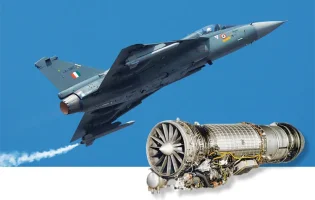
Conversations about the aircraft's powerplant have been ongoing since 2021. Early on, HAL looked at multiple engines, such as the Russian AL-31F (which powers the Su-30MKI) and the American GE F414 (chosen for the Tejas Mk2).
While both of these engines are known for their solid performance and reliability, recent moves indicate HAL is leaning toward an engine in the thrust class of the F414, which generates 98 kN of power.
This preference matches a formal Request for Information (RFI) that HAL published in March 2025. The document specifically asked for a military turbofan engine capable of producing between 95 and 100 kN of thrust, alongside a total technical lifespan exceeding 6,000 hours.
Defence analysts point out that successfully concluding a Transfer of Technology (ToT) deal for the GE F414 engine would be a massive boost for India's local manufacturing industry.
If that agreement is finalized, the GE engine could be fitted into both the HLFT-42 prototypes slated for after 2030 and the eventual production variants.
Sharing the same engine across both the Tejas and HLFT-42 fleets would create excellent logistical synergy. This commonality would drastically reduce both maintenance and everyday operational costs over the lifetime of the aircraft.
Despite leaning to F414, HAL is keeping its options open.
There remains a chance that the aircraft could be upgraded to utilize a more robust 120 kN-class engine, which is currently being developed alongside the French company Safran for the AMCA program.
This final engine decision will largely be driven by comparing costs and determining the exact operational needs of the IAF.
HAL officials have stated that the choice will ultimately depend on whether the Air Force wants a specialized trainer aircraft or a flexible platform that can quickly convert into a frontline fighter.
This level of adaptability means the HLFT-42 could seamlessly transition from teaching pilots into a light combat fighter ready to execute independent strike missions.
Throughout the development cycle, both HAL and the IAF are prioritizing the dependability and steady supply of the final engine choice.
Taking lessons from the delays faced during the HJT-36 Sitara project, HAL is applying modern engineering tools—such as 3D scanning vintage planes like the HF-24 Marut—to guarantee a highly stable aerodynamic profile.
In addition, the Indian Navy has expressed interest in a specialized naval variant of the HLFT-42 to train pilots for its aircraft carriers. This interest could foster better cooperation and equipment sharing between the different branches of the armed forces.
To avoid project delays and speed up the early research phases, HAL has proactively set aside up to ₹1,000 crore from its own corporate funds.
This internal financial backing allows the company to bypass the time-consuming wait for official government funding approvals, strongly reinforcing India's larger drive toward self-reliance in the defence manufacturing industry.