India's leading aerospace manufacturer, Hindustan Aeronautics Limited (HAL), has outlined a major long-term plan to strengthen the nation's armed forces.
Over the next two decades, the state-run company aims to build approximately 1,000 military helicopters falling within the 3 to 15-tonne weight category.
This ambitious target represents a massive step forward for the government's 'Atmanirbhar Bharat' initiative, which seeks to boost domestic defence production and reduce reliance on foreign imports.
Public estimates suggest this initiative is expected to generate a total business of over Rs 4 lakh crore during this 20-year period.
HAL already has strong backing and significant orders from the Indian Army, Navy, Air Force, and Coast Guard.
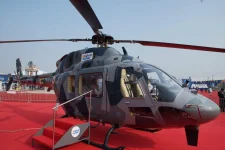
The Advanced Light Helicopter (ALH) Dhruv is currently the foundation of this fleet, with over a hundred units ordered for the Army alone, alongside specialised naval versions.
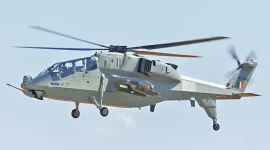
The company's lineup also includes the versatile Light Utility Helicopter (LUH), the armed Rudra, and the dedicated Light Combat Helicopter (LCH) Prachand.
Looking ahead, HAL is developing heavier models like the Indian Multi-Role Helicopter (IMRH) and the Deck-Based Multi-Role Helicopter (DBMRH).
These larger twin-engine helicopters are designed to meet medium-lift needs and will eventually replace older foreign aircraft, such as the Russian-origin Mi-17 series.
To manage this massive fleet expansion of nearly 1,000 new aircraft, HAL is significantly expanding its manufacturing infrastructure.
The centrepiece of this effort is the new 615-acre Greenfield Helicopter Factory in Tumakuru, Karnataka, which was officially inaugurated by the Prime Minister in early 2023.
This state-of-the-art facility will initially produce 30 helicopters a year. However, production capacity will be gradually increased to 60, and eventually up to 90 helicopters annually.
This expanded capacity will guarantee a reliable supply of LUHs, LCH Prachands, and the upcoming IMRHs to meet the continuous demands of the military.
In terms of performance, the existing ALH Dhruv fleet has proven its worth across challenging environments, handling everything from high-altitude missions in the Himalayas to coastal surveillance.
Meanwhile, the LCH Prachand has been custom-built to operate in extreme altitudes and temperatures. Recognising its combat potential, the armed forces have already planned to procure 156 more Prachand attack helicopters to be shared between the Army and the Air Force, further boosting India's aerial firepower.
HAL's long-term strategy goes beyond fulfilling immediate military requirements; the company is also looking at building civilian helicopter models and entering the global export market.
To ensure these new machines are powered by world-class technology, HAL is partnering with international firms, such as France's Safran Group, to co-develop the 'Aravalli' engine for the future IMRH fleet.
Because the military needs to replace roughly 300 to 400 older Russian medium-lift helicopters soon, building them locally will drastically cut down import bills, keep the armed forces ready for any challenge, and create thousands of jobs within the domestic supply chain.
With multi-billion dollar orders backing its factory expansions, HAL is steering India toward becoming a global hub for helicopter manufacturing over the next 20 years.
This massive industrial drive will do more than just strengthen national security; it cements HAL's role as the primary engine of India's self-reliant defence sector.
The transition toward a powerful, 1,000-strong fleet of made-in-India helicopters has officially begun, ensuring improved border deterrence and modernised capabilities for the Indian Armed Forces.