- Views: 2K
- Replies: 3
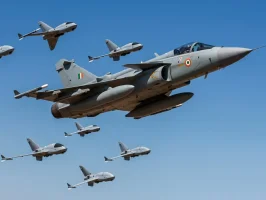
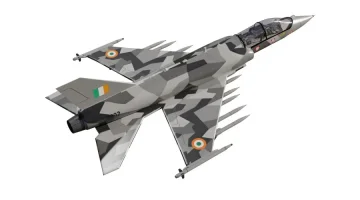
Hindustan Aeronautics Limited (HAL) has introduced a significant design update to its HLFT-42 Lead-In Fighter Trainer (LIFT) programme, marking a decisive shift in the aircraft's aerodynamic configuration.
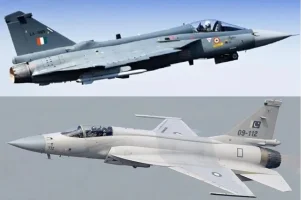
The most notable modification is the complete redesign of the air intakes, moving away from the earlier concept inspired by the HF-24 Marut to a configuration that closely mirrors the Tejas Mk2.
This strategic realignment aims to enhance aerodynamic efficiency, lower development risks, and streamline manufacturing costs.
A Strategic Departure from Tradition
Initial concepts of the HLFT-42, unveiled around 2023, featured a nostalgic design paying homage to India's first indigenous fighter, the HF-24 Marut.These early iterations utilised shock cone (centerbody) intakes positioned on the nose.
While visually iconic, this intake style—common in early supersonic jets—presents complex integration challenges for modern avionics and radar systems.
In the latest design iteration, HAL has replaced these with low-mounted lateral intakes.
This new geometry provides a cleaner nose profile and aligns the trainer visually and aerodynamically with the Light Combat Aircraft (LCA) Tejas Mk2.
Industry observers note that by adopting the proven intake design of the Tejas Mk2, HAL can leverage existing airflow studies and tooling, thereby avoiding the need for parallel and costly aerodynamic testing programmes.
Aerodynamic Refinements and Wing Reconfiguration
The evolution of the HLFT-42 extends beyond the intakes.The wing placement has been adjusted from a low-mounted position to a mid-mounted configuration.
This structural change offers several technical benefits:
- Improved Airflow: The new wing position optimises airflow around the wing roots and fuselage, reducing drag.
- Operational Practicality: It increases ground clearance, facilitating easier loading of external stores and weapons training pods.
- Stability: Subtle reshaping of the dorsal spine and tail sections indicates a focus on longitudinal stability and internal volume management.
Purpose-Built for Training
Despite the strong visual resemblance to the Tejas Mk2, the HLFT-42 maintains distinct differences tailored to its role as a trainer.Most notably, the HLFT-42 lacks the foreplanes (canards) seen on the Tejas Mk2.
- Tejas Mk2: Utilises canards to achieve high agility and rapid nose-pointing capability essential for air combat.
- HLFT-42: Foregoes canards to prioritise aerodynamic stability, predictable handling, and structural simplicity.
With a Maximum Take-Off Weight (MTOW) of approximately 16.5 tonnes, the supersonic HLFT-42 will expose pilots to advanced sensors, avionics, and supersonic flight regimes without the prohibitive costs of operating a twin-seat frontline fighter.
Standardisation for Future Efficiency
The shift towards a standard, contemporary design reflects a pragmatic approach by HAL.The HF-24 style intakes, while sentimental, were less suited for modern high-bypass turbofan engines and active electronically scanned array (AESA) radars.
The new side-intake layout simplifies the integration of these critical systems in the nose section.
By harmonising the design with the Tejas Mk2, HAL is ensuring high commonality in production and maintenance.
For the Indian Air Force, this results in a trainer that not only "looks the part" but also delivers a training environment that accurately replicates the cockpit sightlines and dynamic behaviour of India’s next-generation combat fleet.