- Views: 40
- Replies: 1
Hindustan Aeronautics Limited (HAL) has introduced a newly designed Air-Launched Cruise Missile (ALCM) concept, marking a significant milestone in India's pursuit of advanced, long-range strike weapons.
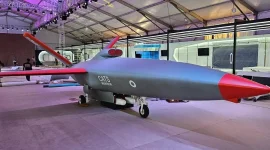
Showcased as part of the Combat Air Teaming System (CATS) framework, this latest missile emerges as a much larger and more sophisticated upgrade compared to the earlier CATS Hunter model.
The weapon features a unique wedge-shaped nose alongside wings that fold outwards, highlighting a clear focus on stealth and the ability to strike from safe distances.
Such structural choices indicate that HAL is developing a highly practical cruise missile specifically built for modern, digitally connected combat scenarios.
Design and Stealth Capabilities
Visually, the new concept dwarfs the original CATS Hunter, pointing to a heavier explosive payload and a longer operational reach.Its structural blueprint serves as a dedicated stand-off weapon built to penetrate highly contested airspace.
Its rectangular body and sharp angles are classic stealth features meant to scatter incoming radar waves.
By minimising its radar cross-section (RCS), the missile becomes much harder for modern air defence networks to detect, ensuring it can survive long enough to hit targets deep inside heavily guarded enemy territory.
Stand-Off Range and Gliding Flight
A key design element is the inclusion of recessed slots along the missile's sides, which conceal its wings while it is attached to an aircraft.Keeping the wings folded reduces both wind resistance and radar visibility before firing. Once launched, the wings deploy to generate lift.
This aerodynamic shift allows the missile to transition into an efficient gliding flight path, significantly extending its travel distance without relying on constant engine thrust.
This makes it an ideal stand-off weapon, allowing the pilot to launch the missile from well outside the reach of hostile anti-aircraft systems.
The original CATS Hunter was designed to weigh roughly 600 kg, carry a 250 kg warhead, and achieve a range of 200 to 300 kilometres using an indigenous HAL PTAE-7 turbojet engine.
Given the notably larger dimensions of this newly unveiled concept, defence analysts anticipate a substantial increase in both its striking range and destructive capability.
The broader CATS project, initiated by HAL alongside private sector partners like NewSpace Research and Technologies, represents an estimated ₹1,000 crore investment aimed at preparing India for artificial intelligence-driven warfare.
Integration into the CATS Network
As a central piece of HAL’s CATS architecture, the new ALCM is built to be fired from a variety of aircraft.It can be carried by manned fighters like the Tejas Mk1A and Su-30MKI, as well as future unmanned drones like the CATS Warrior.
This versatility supports a military strategy known as "distributed lethality," meaning that various aircraft—both piloted and remote-controlled—can work together to launch precision strikes.
It also gives the Indian Air Force the flexibility to mount the weapon on multiple platforms already in its inventory.
Observers have noted that the missile's shape closely mirrors successful Western weapons, such as the European Storm Shadow (SCALP) and the German-Swedish Taurus KEPD 350.
Like its international counterparts, the Indian concept is tailored for covert approaches, exact precision, and destroying hardened targets.
The Future of Indian Air Combat
Building a stealthy cruise missile is a major leap forward for India's aerial warfare strategy, primarily because it keeps pilots and expensive jets out of harm's way.When integrated into the full CATS family—which also features loyal wingman drones, ALFA-S swarm systems, and Infinity high-altitude pseudo-satellites—this missile will help the military conduct highly synchronised attacks.
By combining human-flown jets with autonomous machines, the Air Force can effectively overwhelm and dismantle adversary defences.