- Views: 3K
- Replies: 5
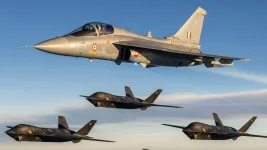
The Tejas Mk2 programme is marking a significant shift in how the Indian Air Force (IAF) approaches indigenous fighter acquisition. Moving away from its traditional position as a strict buyer, the IAF is stepping into the role of an active co-developer.
This strategic pivot aims to ensure the aircraft enters operational service within a tight four-year window following its maiden flight. With the first flight anticipated in roughly 2026, the target is to have the aircraft joining squadrons by the late 2020s or very early 2030s.
This accelerated schedule mirrors global best practices, where modern fighters are inducted with essential combat capabilities first, followed by phased upgrades to tackle emerging aerial threats.
According to sources associated with the programme, a clear division of labour has been established to speed up the process.
While the Aeronautical Development Agency (ADA) and Hindustan Aeronautics Limited (HAL) will manage the initial certification of core weapons—specifically focusing on primary air-to-air and air-to-surface munitions—the IAF will take the lead on subsequent integrations.
This is a major departure from historical protocols, where exhaustive and often redundant testing of every single weapon system by the manufacturer could delay a jet’s entry into service by several years.
To facilitate this rapid induction, the project will prioritise weapons that have already been combat-proven on other IAF platforms.
By adapting existing munitions such as the Astra Beyond Visual Range (BVR) missiles and various precision-guided bombs for the Tejas Mk2, the force can bypass lengthy validation cycles. However, engineers acknowledge that even proven weapons require specific platform trials.
Critical factors such as aerodynamic drag, safe release mechanisms, and digital handshakes with the jet’s advanced systems—including the indigenous Uttam AESA radar and the Unified Electronic Warfare Suite (UEWS)—will still undergo rigorous but targeted assessment.
This strategy, often described as “induct first, upgrade later,” allows the IAF to field the Tejas Mk2 quickly as a potent multi-role fighter with a heavy payload capacity of roughly 6.5 tonnes. By deploying the jet with a robust baseline arsenal initially, the Air Force can iteratively enhance its lethality over time.
Furthermore, by assuming developer-like responsibilities for software coding and advanced systems integration, the IAF is cultivating deep internal expertise.
This reduces long-term reliance on external agencies and ensures the fighter can be updated rapidly to match the operational tempo of modern warfare.
As the Tejas Mk2 moves closer to prototype rollout and flight testing, this collaborative framework serves a dual purpose: it accelerates the fielding of a critical replacement for ageing fleets like the Jaguar and Mirage 2000, and it reinforces India’s strategic autonomy in aerospace defence.
This model positions the IAF not just as a user, but as a key architect of a future-ready, agile, and upgradable indigenous fighter force.