- Views: 4K
- Replies: 6
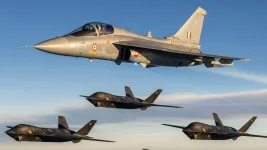
While the Aeronautical Development Agency (ADA) recently secured ₹15,000 crore to initiate the manufacturing phase of the Advanced Medium Combat Aircraft (AMCA), India’s indigenous fifth-generation fighter is only just transitioning from blueprints to physical reality.
However, even as the AMCA project gains necessary speed, the Indian Air Force (IAF) is signalling a critical urgency: the countdown for the subsequent technological leap has already begun.
Recent statements by Air Chief Marshal A P Singh, suggesting that India may need to collaborate with friendly nations to expedite the development of next-generation combat platforms, are being interpreted as a significant strategic shift rather than mere commentary.
Defence experts view these remarks as a directive to India’s aerospace designers that the IAF is unwilling to wait until 2040 or later for a sixth-generation aircraft to be delivered through a wholly indigenous timeline.
For the ADA, which recently achieved a major milestone with the government’s sanction of the AMCA programme, the mandate is now doubly demanding.
The agency must ensure the timely delivery of India’s first stealth fighter—expected to roll out prototypes by 2028-29—while simultaneously laying the groundwork for a sixth-generation platform.
This parallel effort is essential in an era where global air power capabilities are advancing at an unprecedented pace.
Leading global air forces are rapidly moving ahead.
The United States Air Force is well advanced in flight testing for its Next Generation Air Dominance (NGAD) programme, while China is reportedly making swift strides with its own sixth-generation concepts, potentially fielding them before 2035.
Furthermore, consortia such as the Global Combat Air Programme (GCAP)—involving the UK, Japan, and Italy—are aiming for similar timelines.
The induction of these platforms by the mid-2030s could fundamentally alter the balance of air power in the Indo-Pacific region.
In this context, Air Chief Marshal Singh’s support for a joint venture model is highly significant.
It indicates a growing realisation within the IAF that while India has established a credible domestic aerospace ecosystem, the extreme complexity of sixth-generation technology makes a purely independent development path strategically risky and potentially too slow.
Sixth-generation fighters will represent a paradigm shift beyond merely stealthier versions of current jets.
These aircraft will function as flying command centres, integrating artificial intelligence, 'loyal wingman' drones, manned-unmanned teaming (MUM-T), adaptive cycle engines, and directed energy weapons into a fully networked combat cloud.
Developing such a comprehensive suite of technologies in isolation could take decades.
Consequently, the Air Chief’s comments are seen as a message to the ADA to commence parallel development immediately. While the AMCA serves as a necessary stepping stone, the ultimate goal lies beyond it.
The current funding for the AMCA ensures India’s entry into the fifth-generation arena, with induction likely in the mid-2030s. However, by the time the AMCA is fully operational, major global powers may already be operating sixth-generation fleets, creating a technological gap the IAF deems unacceptable.
A joint development programme with a partner nation would enable India to compress these development timelines significantly.
Such a collaboration would provide early access to cutting-edge technologies and ensure that India’s air combat doctrine matures alongside the world’s most advanced forces.
It would also allow the ADA and Indian industry to absorb sixth-generation design philosophies while retaining sovereignty over production and future upgrades.
Ultimately, the Air Chief’s remarks serve as a strategic nudge rather than criticism. While the success of the AMCA is vital, it cannot mark the end of India’s aerospace ambitions.
To remain a premier air power in the 2040s, work on a sixth-generation platform must begin well before the AMCA reaches operational maturity.
The message from the IAF is clear: India has demonstrated its ability to design modern fighters; now, it must prove it can match the speed of future warfare.