IAF Showcases Rafale with Meteor BVRAAM at R-Day, Quells Speculations of Integration Delays

IAF Showcases Rafale with Meteor BVRAAM at R-Day, Quells Speculations of Integration Delays


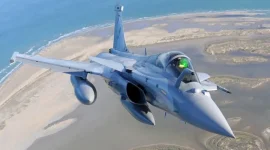
For Indian aviation enthusiasts and defence observers, the wait for definitive proof is finally over. The Indian Air Force (IAF) has publicly confirmed that its fleet of Dassault Rafale fighters is fully equipped with the lethal Meteor beyond-visual-range air-to-air missiles (BVRAAMs).

This confirmation came in the form of high-resolution imagery captured during today’s Republic Day flypast over Kartavya Path, effectively putting an end to months of suspense regarding the weapon system's operational status.

Ending the Speculation​

For a considerable period, the defence community has been rife with questions regarding the integration of the Meteor missile with the Indian Rafale fleet.

The Meteor is widely regarded as a game-changer in aerial combat, featuring a unique ramjet propulsion system that allows it to throttle its engine during flight.

Unlike traditional solid-fuel missiles that burn out quickly, the Meteor maintains powered flight to the target, offering an operational range in excess of 100 km and a "no-escape zone" significantly larger than comparable weapons.

This capability was a primary driver behind India’s procurement of the Rafale, promising unmatched dominance against regional aerial threats.

Despite these capabilities on paper, doubts had lingered in the public sphere.

Speculation was fuelled by the absence of the missile in previous public displays and exercises, leading some analysts to theorise that certification hurdles or supply chain delays might be hindering its deployment.

The lack of clear visual evidence had sparked intense debate on online defence forums about whether the IAF had truly cleared the weapon for frontline combat duties.

Visual Confirmation over Kartavya Path​

The narrative shifted decisively on 26 January as the IAF executed a spectacular aerial display for the 77th Republic Day celebrations.

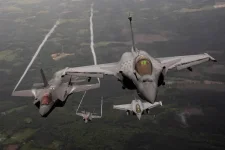
During the flypast, multiple Rafale jets participated in complex formations, including the "Sindoor" spearhead group and the six-aircraft "Vajraang" formation.

Sharp-eyed observers immediately noted that several of these jets were carrying live ordnance under their wings.

Within minutes, images taken by broadcasters and amateur spotters began circulating on social media.

Although some initial photos were grainy—zoomed-in shots from vantage points along the parade route—they provided undeniable evidence.

The missile’s distinctive intake ducts, elongated fuselage, and specific fin configuration matched the profile of the MBDA Meteor perfectly.

Veteran aviation trackers, some of whom have chronicled IAF serial numbers for decades, corroborated the sighting, celebrating it as the first public validation of the Meteor in Indian skies.

Operational Maturity​

The timing of this reveal is significant, coming shortly after "Operation Sindoor," a high-intensity aerial campaign where the Rafale fleet played a central role in precision strikes.

The display serves as a subtle yet powerful rebuttal to earlier scepticism. It signals that the IAF has not only taken delivery of the missiles but has also fully integrated them into its standard operating procedures.

For defence experts, these visuals represent a critical milestone. The presence of the Meteor in a high-visibility national parade indicates that the system is no longer merely a contractual promise or a test asset; it is a fully operational reality.

This integration substantially enhances India's air defence posture, providing a credible deterrent in contested airspace.

As the roar of the engines faded over Delhi, the message delivered by the images remained clear: the Rafale’s most potent long-range capability is active, cleared, and ready for deployment.

In an age where visual proof often carries more weight than official statements, today’s flypast has settled the debate once and for all.
 
The reason for super inflated price of Rafale, most than three times the price offered to UPA Govt was that all the 36 would come full armed! So what happened?
You have made a series of posts. Let's take them one by one.

About price. The UPA days price was barebones price. Only ac nothing else. The 36 deal price included, R&D and integration cost for 43 India specific enhancements, training, infrastructure for two bases, simulators and other training materials, maintenance package, and off course complete weapons inventory.

This is the practice the world over. Flyaway cost means nothing.
 
We do not know if all the things on paper actually work. The Rafale and all other western jets have never faced peer level opposition. They only faced opponents without any air defence and no airforce! Hope good and true patriotism prevail. Jai Hind.
That is silly assertion. Current wars are all one sided where air power in concerned. So your assertion specifically about Rafale is deliberate falsification.
 
Rafale air frame may.not be able to heavy munition it cannot handle our Brahmos. Most western jets are fragile and delicate. Some time back and F35 made emergency landing in Kerala. It took a planeload of techies with equipments flown in 35 days to get it into the air again. Imagine is a war scenario. All western jets n equipment need very high super specialized maintenance. Such technis ok for race track. But during war where there are explosions, fire smoke, debris... We need robust, durable jets n equipments. Like our trusted Migs & Sukhois. Jai Hind.
One one side you say may not be able and in the same breath you assertion something else. Are you aware that not all Sukhois can carry the Brahmos. Yes, some were specially modified. Because when the ac was designed, Brahmos-A was not in the picture. Similarly, the Rafale was never designed for the Brahmos. You need to get your basic engineering knowledge right. These are not trucks that you dump any load anywhere.

The comparison with F-35 displays your total lack of knowledge about the issue. Rafales in IAF have proved over 90% availability rate, a record.
 
This is true the Rafale is Best for the Showcase. Not for war! We have Migs, Sukhois and S400 for defending Bharatmata. Jai Hind.
Thank God you have nothing to do with IAF task or policy. Your statement shows that. The IAF fellows are professionals, who know what they are doing. India is grateful for that.
 
That is why we should keep away from western defence equipment. They v expensive and never work as they expected. Case in point our Rafales could not detect incoming missiles until too late. Our pilots thought as advertised after detection they would have time to evade. Then Dassault blamed our Intelligence for give wrong info about enemies missile range. Now everyone is denying that we lost any Rafale. Pathetic! It is best we shun this expensive toy plane and focus on our Tejas . Jai Hind!
In theory you are correct. Unfortunately, India is not ready and is still learning and perfecting the Tejas. We can't wait, we need stop gap measures. We have no choice. The MOD knew this in 2014. They believed the bullshit and were fed what they wanted to hear. There is nothing wrong with working with another country to develop technology. Everyone does it, why can't we.
 
In theory you are correct. Unfortunately, India is not ready and is still learning and perfecting the Tejas. We can't wait, we need stop gap measures. We have no choice. The MOD knew this in 2014. They believed the bullshit and were fed what they wanted to hear. There is nothing wrong with working with another country to develop technology. Everyone does it, why can't we.
In the first place Tejas and Rafale are different classes of ac. There is no comparison. The Tejas can not do the job of a Rafale. The Rafale can do the job of a Tejas but it will be very expensive.

Let's not spread canards about Tejas and Rafale comparison. Even the Tejas Mk2, if it meets all design specifications can not match the Rafale.
 
The reason for super inflated price of Rafale, most than three times the price offered to UPA Govt was that all the 36 would come full armed! So what happened?
The price during MMRCA was 714 crore while that of 2016 deal was 1640 crore (per jet) so that's not more than 3 times, and meteor entered service 3 years after first rafale batch, also as one rafale shotdown speculations amplify , it's a common sensual question that why meteor wasn't fired against PL15
 
We do not know if all the things on paper actually work. The Rafale and all other western jets have never faced peer level opposition. They only faced opponents without any air defence and no airforce! Hope good and true patriotism prevail. Jai Hind.
Tejas is purely on paper, and you think that a combat proven aircraft is better than or even comparable to it, both are entirely different platforms which are incomparable,you have Practically no other option than going with rafale currently
 
Keeping a bottle of water in a car is the decision of the user but the bottle holder is installed when the car is manufactured.

When one talks about integration of a weapon in an ac, it means whether the wiring, other hardware and requisite software is installed. That happens during production. Whether to hang the weapon is the decision of the user, much like keeping a water bottle in the car

Only in case a new class of weapons are designed subsequently, then integration issue comes up. One example would be the Gandiva, as and when it is developed and certified. If the decision is made to equip our Rafales with those, then they will be INTEGRATED in due course.
That's what the debate is about,,, that were meteor available/equipped/used during conflict, if no, then why and if yes, then there's no A2A kill recorded, also did they lagged behind PL15
 

Forum statistics

Threads
6,215
Messages
62,344
Members
4,882
Latest member
विवेक
Back
Top