- Views: 3K
- Replies: 4
The Indian Air Force (IAF) has clarified its strategic roadmap regarding future fighter acquisitions, emphasising that the French Rafale and the Russian Su-57 are not competing for the same spot in its inventory.
Instead, defence officials view these two platforms as parallel solutions to distinct challenges: one aimed at rapidly restoring combat mass, and the other at providing an immediate stealth capability to counter regional threats.
Addressing the Squadron Deficit
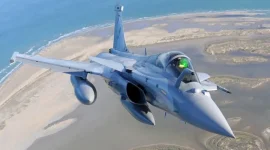
The primary objective of acquiring an additional 114 Rafale fighters is to stabilise the IAF’s dwindling squadron numbers.With the retirement of legacy fleets such as the MiG-21 and MiG-27, the IAF’s fighter strength has fallen to approximately 31 squadrons—well below the government-authorised strength of 42 required for a two-front war scenario.
In this context, the Rafale is viewed as a mature, combat-proven "workhorse." As a 4.5-generation multirole platform, it offers deep strike, nuclear delivery, and air dominance capabilities.
Its role is to serve as the backbone of India’s conventional air power through the 2030s, replacing ageing aircraft with a modern, high-performance jet that can be inducted in significant numbers without delay.
The Stealth Gap
While the Rafale shores up numbers, it lacks the stealth features required to penetrate highly contested airspace undetected.This qualitative gap has become a major concern for defence planners, particularly as China accelerates the deployment of its fifth-generation J-20 "Mighty Dragon" fighters.
Current estimates suggest China already operates a fleet exceeding 300 stealth aircraft, creating a technological asymmetry that 4.5-generation jets cannot fully offset.
To address this, the IAF is evaluating the procurement of two to three squadrons of the Su-57 as an interim strategic asset.
This acquisition is not intended to replace the Rafale but to serve as a specialized "door-kicker"—a low-observable platform capable of neutralising advanced air defence systems and clearing the path for non-stealth fighters.
This stopgap measure is vital to ensure credible deterrence until India’s indigenous Advanced Medium Combat Aircraft (AMCA) becomes operational, which is currently projected for induction around 2035.
Leveraging Existing Infrastructure
A key factor favouring the expansion of the Rafale fleet is the robust ecosystem already established in India.The IAF has operationalised Rafale bases at Ambala and Hasimara, complete with maintenance depots, weapons storage for Meteor and SCALP missiles, and pilot training simulators.
Inducting more Rafales into this existing setup would be significantly faster than introducing a new aircraft type from scratch.
Defence officials estimate that bypassing the initial setup phase could save three to four years, allowing the IAF to achieve full operational capability much sooner—a critical advantage given the volatile security environment along the borders with Pakistan and China.
Strategic Autonomy and Future Force Structure
In contrast to the off-the-shelf nature of the Rafale purchase, any potential deal for the Su-57 would likely focus on deep technology transfer.The IAF is keen on ensuring sovereign control over the aircraft’s mission software and weapon integration, allowing it to adapt the Russian platform to Indian operational doctrines.
Looking ahead, the IAF envisions a three-tiered combat fleet:
- The Core: Rafale and Su-30MKI providing heavy multirole capability.
- The Mass: Indigenous Tejas Mk1A and Mk2 forming the bulk of the light and medium segments.
- The Future: The AMCA serving as the eventual fifth-generation cornerstone.