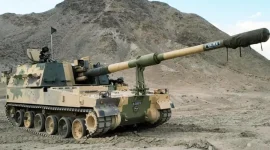
The Indian Army is currently assessing an innovative strategy to safeguard its armored divisions from modern aerial threats by mounting 10-kilowatt laser weapon systems on its T-90 and Arjun Main Battle Tanks.
This initiative aims to protect tank formations from the increasing dangers of First-Person View (FPV) drones, suicide UAVs, and coordinated drone swarms.
According to defence sources, this evaluation is a direct response to the tactical shifts witnessed in the ongoing Russia-Ukraine conflict.
In that war, inexpensive drones have heavily compromised the survival of traditional mechanized units.
By targeting vulnerable areas such as turrets, engine blocks, and ammunition storage, even small drones have managed to disable heavily armored vehicles.
To counter this, the Army is considering a "shield tank" model.
Instead of relying entirely on external air defence units, a select few tanks within a convoy would be fitted with directed-energy weapons and automated close-in weapon systems (CIWS).
Operating much like specialized electronic warfare aircraft that protect fighter jets during strikes, these specially equipped tanks would act as mobile defence nodes.
Together, they could project a protective canopy over an entire strike group of 20 to 40 moving tanks.
While many global armed forces initially reacted to the drone threat by welding temporary metal "cope cages" to tank roofs, these passive barriers have proven inadequate against sophisticated swarm tactics and precision munitions.
Consequently, the focus has shifted toward active protection systems that actively intercept or destroy incoming threats.
The proposed 10 kW laser shield is designed to blind optics, disrupt flight controls, or physically melt through the propellers and guidance hardware of low-flying loitering munitions.
This concept builds heavily on India's rapidly advancing indigenous directed-energy capabilities.
Just last year, the Defence Research and Development Organisation (DRDO) successfully demonstrated the 30 kW Mk-II(A) Directed Energy Weapon, placing India in an elite group of nations possessing operational technology capable of instantly shooting down fixed-wing and swarm drones.
Integrating lasers into ground combat brings major tactical advantages. Unlike traditional missile interceptors, laser weapons boast a nearly limitless magazine capacity and an exceptionally low cost per shot.
As long as there is an electrical supply, they can fire repeatedly at the speed of light, making them the ideal countermeasure against cheap, mass-produced commercial drones that can appear and strike within seconds.
However, successfully mounting these sensitive systems onto main battle tanks remains a complex engineering challenge.
Armored vehicles must endure extreme vibrations, heavy dust, and rough terrain while maintaining exact line-of-sight targeting.
Furthermore, tanks were not originally built to power high-energy weapons.
Delivering a stable electrical supply and managing the intense heat generated by continuous laser firing will likely require auxiliary power units and sophisticated cooling mechanisms.
Despite the technical hurdles, the Indian Army's pursuit of a mobile anti-drone laser shield mirrors a broader international movement.
Major military powers across the globe are actively developing layered, directed-energy defence systems to ensure their heavy armor can survive the battlefields of tomorrow.