- Views: 3K
- Replies: 6
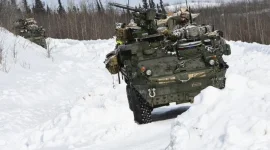
The Indian Army’s proposed acquisition of the US-manufactured Stryker armoured fighting vehicle appears to have hit a definitive roadblock.
According to a recent report by Times Now, enthusiasm for the platform within the military establishment has significantly waned, casting serious doubts on whether the deal will proceed.
While the Stryker was initially viewed as a strong contender to enhance the Army’s rapid deployment and amphibious capabilities, recent assessments indicate the programme has lost critical momentum.
Evaluations Failed to Impress
The dampening of interest follows a series of rigorous evaluations, including high-profile trials conducted during the 'Yudh Abhyas' joint military exercises in Alaska earlier this year.The report highlights that while these exercises provided a platform to test the Stryker’s performance in extreme cold-weather environments—conditions similar to India’s northern borders—the results did not translate into sustained interest from New Delhi.
Despite the vehicle’s established operational history with US forces, the Indian Army’s exposure to the platform in these demanding settings reportedly failed to demonstrate a significant advantage over existing or alternative solutions.
Sources cited in the report suggest that despite the intense diplomatic push, the operational appetite to induct the Stryker has effectively evaporated.
Operational and Technical Mismatches
The Stryker was being explored as part of a broader modernisation drive to equip the Indian Army’s mechanised infantry with versatile mobility platforms capable of navigating diverse terrains, including riverine and amphibious sectors.However, evolving doctrinal priorities and specific technical limitations have seemingly reduced the vehicle's relevance.
Open-source defence analysis indicates that the Stryker’s standard 350-horsepower engine was found wanting when compared to the demanding power-to-weight ratios required for high-altitude operations in regions like Ladakh and Sikkim.
Furthermore, the Indian Army has placed a premium on true amphibious capabilities for its wheeled armoured platforms. Reports suggest the Stryker’s limitations in traversing water bodies without extensive preparation contrasted sharply with the Army’s requirement for immediate 'swim' capabilities.
Shift Toward Indigenous Solutions
Consequently, the likelihood of the acquisition process moving forward is now described as minimal. This development signals a strategic pivot back towards indigenous alternatives that better align with the Army's long-term operational concepts and the national "Atmanirbhar Bharat" initiative.The primary beneficiary of this shift is likely to be the indigenous WhAP (Wheeled Armoured Platform), jointly developed by the DRDO and Tata Advanced Systems.
Unlike the Stryker, the WhAP was designed from the ground up to meet Indian specifications, featuring a more powerful 600-horsepower engine and inherent amphibious capabilities.
If confirmed, the shelving of the Stryker proposal would close the chapter on what was once touted as a marquee India–US defence collaboration project.
It reinforces a growing trend where the Indian Army prioritises systems—whether domestic or foreign—that offer strict compatibility with its unique logistical ecosystem and operational needs over geopolitical considerations.