- Views: 5K
- Replies: 7
The narrative surrounding the Indian Air Force’s (IAF) Su-30MKI fleet has long been dominated by debates over delayed modernisation.
With squadron strength falling and timelines for the Rafale and Tejas Mk2 stretching further into the future, critics have often pointed to a "lost decade" in upgrading India’s frontline fighter.
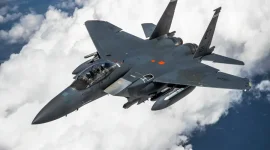
However, defence analysts now argue that this delay has inadvertently created a unique strategic opening: the chance to launch a "Super Sukhoi" program that mirrors the philosophy of the American F-15EX, transforming a legacy airframe into a cutting-edge dominance fighter using purely Indian technology.
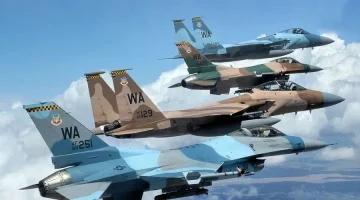
The parallel between the Russian-designed Su-30 and the American F-15 is striking. Both platforms were born in the Cold War era of the late 1970s yet remain central to their respective air forces due to their sheer payload capacity and range.
While the United States successfully evolved the F-15 into the F-15EX "Eagle II"—a missile truck packed with next-generation avionics—the Su-30MKI has awaited a similar leap.
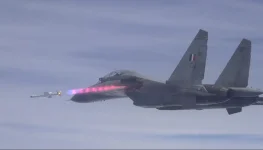
In terms of raw kinematics, the Indian Flanker already holds a distinct advantage over the F-15 family, featuring superior aerodynamics and 3D thrust-vectoring engines.
The missing link has been the electronic sophistication of the modern battlefield—a gap that India’s Defence Research and Development Organisation (DRDO) is now fully equipped to close.
After more than a decade of discussions, the "Super Sukhoi" upgrade is no longer reliant on foreign vendors. With the maturation of India’s domestic defence ecosystem, the IAF has the opportunity to integrate indigenous sensors and systems that could make the Su-30MKI EX a global standout.
The proposed upgrade focuses on four critical pillars:
1. The Virupaksha AESA Radar Advantage
The centrepiece of the upgrade is the transition from the older passive scanning radar to the indigenous 'Virupaksha' Active Electronically Scanned Array (AESA) radar.Built on the success of the Uttam radar developed for the Tejas fighter, the Virupaksha is a scaled-up, high-power variant designed specifically for the Su-30’s large nose cone.
- Capability Leap: Featuring nearly 2,400 Transmit/Receive (T/R) modules and Gallium Nitride (GaN) technology, this radar would vastly exceed the detection ranges of current regional threats.
- Operational Edge: It enables the simultaneous tracking of air and ground targets while offering superior resistance to enemy jamming, effectively bringing the aircraft to a 4.5+ generation standard.
2. Next-Generation Electronic Warfare (EW) Suite
Modern aerial combat is determined as much by the electromagnetic spectrum as by missiles.The proposed upgrade includes a comprehensive, DRDO-developed EW suite. This system integrates a digital Radar Warning Receiver (RWR) with advanced self-protection jammers.
Such an addition would grant the Su-30MKI the ability to blind enemy sensors and survive in highly contested airspace along the Chinese and Pakistani borders—a capability that is critical for a heavy fighter.
3. Advanced Countermeasures and Towed Decoys
To counter the proliferation of long-range air-to-air missiles like the PL-15 or AIM-120, the upgraded Su-30MKI is expected to feature a combination of Self-Protection Jammers (SPJ) and Fibre-Optic Towed Decoys.These decoys act as a lure for incoming radar-guided missiles, drawing them away from the aircraft. This technology has become a standard requirement for modern survivability and would be a first for an operational Indian fighter.
4. The Case for the AL-41F-1S Engine
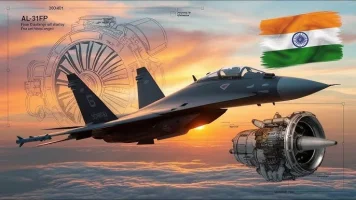
While the current AL-31FP engines have served the fleet well, a shift to the AL-41F-1S (117S family) engines is widely viewed as the final piece of the puzzle.Although India recently approved a contract for additional AL-31FP units, proponents of the "Super Sukhoi" argue that the 117S offers decisive advantages for the future:
- Performance: A 15% increase in thrust would further enhance the jet's legendary supermaneuverability.
- Efficiency: Improved fuel economy and reliability would lower lifecycle costs and extend the airframe’s service life well into the 2040s.
- Dominance: The added power would ensure the aircraft retains its energy advantage during high-stakes dogfights and heavy-payload strike missions.
Strategic Independence
Perhaps the most significant aspect of this upgrade is not technical, but strategic.By replacing Russian subsystems with Indian mission computers, avionics, and weapons, the "Super Sukhoi" project would effectively "Indianise" the platform.
This shift drastically reduces dependency on Moscow for maintenance and upgrades, insulating the IAF from geopolitical supply chain disruptions.
Ultimately, an indigenised Su-30MKI offers the Indian Air Force sovereign control over its most potent asset.
It promises faster, cost-effective upgrades and the ability to modify source codes to integrate new weapons at will—capabilities that remain impossible when relying on foreign original equipment manufacturers.