- Views: 2K
- Replies: 2
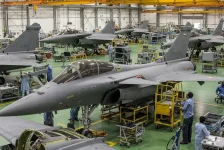
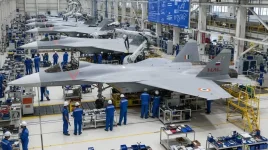
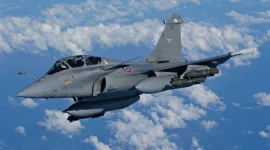
India’s upcoming fleet of locally manufactured Rafale fighter jets is expected to be delivered in a distinct "F4 Plus" configuration, a standard that reportedly exceeds the baseline F4 model currently being inducted by the French Air and Space Force.
Sources indicate that this variant will feature a sovereign, India-specific digital architecture designed to ensure complete operational independence.
While Dassault Aviation has positioned the F4 standard as a significant generational leap in air combat capabilities, India is pursuing a bespoke version tailored to its unique requirements.
Unlike the standard French model, the Indian "F4 Plus" aims to seamlessly merge with the Indian Air Force’s (IAF) existing indigenous command-and-control networks.
This move aligns with recent reports suggesting that New Delhi is negotiating a government-to-government deal for 114 multi-role fighter aircraft (MRFA), which may include a mix of locally produced F4 variants and the futuristic F5 "Super Rafale."
The central pillar of this "F4 Plus" initiative is the integration of sovereign Indian secure data links.
These indigenous communication systems will enable the Rafale fleet to exchange real-time tactical data with Indian assets, such as the Netra and Phalcon Airborne Warning and Control Systems (AWACS), ground-based radars, and the Integrated Air Command and Control System (IACCS).
By allowing the direct transmission of high-resolution targeting data and battlefield intelligence to Indian controllers, this capability will drastically enhance situational awareness and reduce the "sensor-to-shooter" loop time, a critical factor in modern aerial warfare.
Achieving this level of interoperability presents substantial engineering and certification hurdles.
To accommodate sovereign data links and Indian-designed weaponry—such as the Astra air-to-air missile—Dassault Aviation will need to modify the aircraft’s mission computers and open up specific segments of its avionics architecture.
This process involves deep-level integration within the aircraft’s sensor fusion engine, a complex task that typically requires access to proprietary source codes or extensive collaboration on software-defined avionics.
Such digital autonomy is vital for India’s long-term defence strategy. It ensures that the operational effectiveness of its frontline fighters remains immune to external restrictions or foreign-controlled electronic gates.
By controlling the data architecture, the IAF can guarantee that its combat operations are secure and independent, a necessity given the contested airspace on India’s northern and western borders.
While Dassault’s baseline F4 upgrade already introduces potent capabilities, India’s roadmap envisions a mixed fleet comprising these "F4 Plus" jets and the future Rafale F5 standard.
The F4 standard itself brings the advanced RBE2 Active Electronically Scanned Array (AESA) radar, which offers superior detection ranges and resistance to jamming.
Additionally, it features the CONTACT software-defined radio and an upgraded SPECTRA self-protection suite, which creates a "defensive bubble" around the aircraft to jam enemy radars and counter surface-to-air threats.
The operational edge of the F4 standard is further sharpened by its ability to deploy next-generation munitions. These include the Meteor beyond-visual-range air-to-air missile and extended-range air-to-ground precision weapons like the SCALP and HAMMER.
Furthermore, the enhanced satellite communication links planned for the F4 allow the aircraft to function as a high-speed node in a networked environment, sharing target data across air, land, and sea domains.
Looking further ahead, the roadmap for the F4 and the subsequent F5 variants places a heavy emphasis on artificial intelligence.
The updated avionics suite will incorporate AI-driven decision support tools designed to help pilots manage the overwhelming flow of data during high-intensity combat.
These algorithms will assist in prioritising threats and fusing sensor data, thereby reducing the pilot's cognitive workload and enabling faster tactical decisions in dynamic scenarios.
For the Indian defence establishment, the transition to the F4 Plus configuration is not merely a technical upgrade but a strategic shift toward a digitally sovereign combat ecosystem.
This approach envisions a unified network where locally made fighters operate in perfect sync with indigenous surveillance platforms and satellites.
If the deal for local production concludes as anticipated, the Indian-manufactured Rafales will be the first globally to field this specific "Plus" standard, setting a new benchmark for how 4.5-generation fighters can be adapted for fifth-generation digital warfare.