- Views: 1K
- Replies: 4
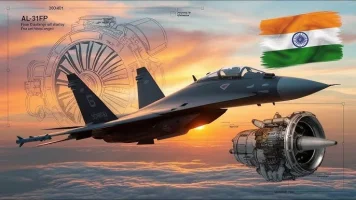
The Indian Air Force (IAF) is approaching a defining crossroad in the modernization of its Sukhoi Su-30MKI fleet.
Recent reports suggest that the IAF is weighing a Russian-sourced upgrade package against the domestic "Super Sukhoi" plan proposed by Hindustan Aeronautics Limited (HAL).
This decision will determine whether the backbone of India’s air defence remains reliant on evolved hybrid radar technology or shifts toward a next-generation indigenous electronic warfare capability.
The Technology Debate: PESA vs. AESA
At the heart of this strategic choice is the aircraft's fire control radar.As aerial combat moves toward stealth-dominated environments and long-range missile exchanges, the type of radar integrated into the Su-30MKI will dictate its effectiveness for the next two decades.
The Russian proposal centers on the Irbis-E, a Passive Electronically Scanned Array (PESA) radar currently utilized by the Russian Aerospace Forces on the Su-30SM2 and Su-35S.
While the Irbis-E is a highly refined version of the existing "Bars" radar, it represents the physical peak of PESA technology rather than a jump to a new architecture.
- Capabilities of Irbis-E: It offers a massive detection range of up to 400 kilometres against fighter aircraft and can track 30 targets at once.
- The Limitation: Despite its raw power, PESA systems generally lack the advanced stealth-detection, reliability, and electronic counter-countermeasure (ECCM) resilience found in Active Electronically Scanned Array (AESA) systems.
The Indigenous Contender: Virupaksha AESA
In contrast, HAL’s modernization roadmap focuses on the Virupaksha, an indigenous AESA radar. Unlike the Russian system, the Virupaksha utilizes advanced Gallium Nitride (GaN) technology.This provides superior thermal efficiency and higher power density, allowing the radar to operate more effectively in high-heat and high-interference environments.
Projections for the Virupaksha are ambitious, with detection envelopes exceeding 400 kilometres for standard fighters and over 600 kilometres for larger aircraft.
If successful, this would transition the Su-30MKI from a traditional fighter into a "mini-AWACS" capable of coordinating networked strikes and detecting low-observable (stealth) threats at significant distances.
| Feature | Irbis-E (Russian PESA) | Virupaksha (Indian AESA) |
|---|---|---|
| Technology Type | Hybrid PESA | GaN-based AESA |
| Detection Range (Fighter) | ~400 km | 400+ km |
| Detection Range (Large) | Not specified | 600+ km |
| Modules | Single Transmitter | 2,400 - 2,600 T/R Modules |
| Operational Status | Battle-proven / In production | Under development |
Strategic Implications and Risks
The IAF faces a classic "reliability vs. innovation" dilemma. Choosing the Russian Irbis-E ensures a swift, proven upgrade that maintains high interoperability with existing Russian-made systems.However, it may leave the fleet technologically stagnant as regional adversaries increasingly deploy fifth-generation stealth platforms.
The Virupaksha offers a significant qualitative advantage but carries developmental risks.
The indigenous radar is estimated to be several years away from full-scale production and operational maturity.
Open-source intelligence indicates that India is simultaneously working on the Uttam AESA radar for the Tejas program, suggesting that while the technical expertise is growing, the timeline for the larger Virupaksha remains a critical factor.
Looking Ahead
As the IAF looks toward 2030, the choice will likely be influenced by India's broader "Atmanirbhar Bharat" initiative.While a Russian-led upgrade provides immediate relief for fleet fatigue, integrating the Virupaksha—even within a broader international framework—would ensure the Su-30MKI remains a dominant force in a contested networked battlespace.