- Views: 2K
- Replies: 5
The Philippines has initiated discussions with India regarding the acquisition of an indigenous medium-range surface-to-air missile (SAM) system.
This potential procurement is aimed at replacing the Philippine Air Force’s aging inventory of MIM-23 Improved HAWK batteries, which were originally sourced from the United States during the 1990s.
Reports suggest this move aligns with Manila's broader efforts to secure modern defence capabilities under its ongoing modernization programme.
Challenges with Legacy Systems
Currently, the Philippine Air Force maintains operation of a solitary upgraded HAWK XXI battalion stationed at Clark Air Base.However, this system is facing significant obsolescence issues. It offers a limited engagement envelope, capable of intercepting aircraft at ranges of approximately 40-45 km and cruise missiles at 20-25 km.
Maintaining the system’s combat readiness has become increasingly arduous due to its reliance on analogue-era technology and a scarcity of spare parts.
Consequently, under the 'Horizon 2' and 'Horizon 3' modernization phases—recently revamped as 'Re-Horizon 3' with a focus on archipelagic defence—Manila is actively seeking network-centric replacements to bolster its air defence umbrella.
India Proposes the Akash-1S
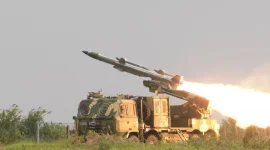
In response to Manila's requirements, New Delhi has put forward the Akash-1S air defence system. This variant represents the latest production standard of the SAM family manufactured by Bharat Dynamics Limited (BDL), which is already actively deployed by both the Indian Army and the Indian Air Force.The Akash-1S is a sophisticated, mobile air defence solution featuring an indigenous seeker and advanced electronic counter-countermeasures (ECCM) to operate in contested environments.
It boasts a reported engagement range of up to 45 km against fighter-sized targets and remains effective against low-flying cruise missiles at ranges of up to 30 km.
A standard battery unit is highly mobile, mounted on 8×8 high-mobility vehicles, and consists of:
- Four self-propelled launchers, each carrying eight ready-to-fire missiles.
- A battery-level command post.
- A 3D phased-array engagement radar derived from the Rajendra radar system.
Strategic Fit and Limitations
The Akash-1S is viewed as a suitable solution for the quick-reaction, all-weather defence of critical strategic assets, such as Subic Bay, Clark Air Base, and prospective outposts in Palawan facing the West Philippine Sea.However, sources indicate that Manila had initially hoped for a system with a longer reach—specifically in the 50-80 km class—to provide wider area denial against stand-off threats.
While India is developing the more capable Akash-NG (New Generation), which features a lighter composite airframe, a dual-pulse motor for a larger "no-escape zone," and a compact Active Electronically Scanned Array (AESA) seeker with a range of 70-80 km, it is not yet available for export.
The Akash-NG is currently undergoing final user trials with the Indian Air Force and lacks the necessary production clearance and export authorization from the Indian Ministry of Defence.
Rationale for the Offer
According to defence insiders, India has ruled out offering other potential systems such as the QRSAM (Quick Reaction SAM), which has a range of over 30 km, or the MRSAM-ER (Medium-Range SAM Extended Range), a joint development with Israel capable of reaching 70-100 km.These systems are considered either too short-ranged for the Philippines' specific needs or are bound by sensitive technology-sharing restrictions.
Consequently, the Akash-1S stands as the primary exportable option. With a production run exceeding 3,000 missiles and a proven combat record in Indian service, it offers Manila an immediate and reliable solution.
Open-source intelligence suggests that if finalized, this deal could be valued at approximately $200 million, marking another significant milestone in India-Philippines defence cooperation following the successful BrahMos missile agreement.