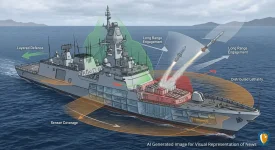
India's Defence Research and Development Organisation (DRDO) is spearheading a groundbreaking initiative to secure the nation's airspace.
Officially designated as the Extended Range Air Defence System (ERADS) and popularly known as Project Kusha, this ambitious programme—operating with an estimated budget of ₹21,700 crore—aims to establish a formidable, multi-layered air defence shield.
At the core of this project are three highly capable interceptor missiles: M1, M2, and M3.
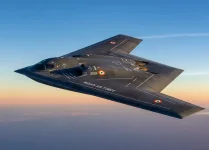
These interceptors are engineered to neutralise a wide spectrum of aerial threats, ranging from agile fighter jets and stealth drones to airborne early warning systems (AWACS) and tactical ballistic missiles.
A defining innovation of Project Kusha is DRDO's strategic decision to utilise a universal "base missile" architecture across all three variants.
This modular approach significantly cuts down on development time, reduces logistical hurdles, and accelerates manufacturing, all while maximising the system's lethal precision.
Interceptor M1: The Foundation of the Fleet
The M1 interceptor serves as the foundational pillar of the Project Kusha family.Engineered with a compact two-stage solid rocket motor, the M1 boasts an operational range of up to 150 kilometres.
It is specifically tailored to counter fast-moving, highly manoeuvrable threats such as cruise missiles, loitering munitions, and tactical fighter jets.
The missile utilises a high-speed booster designed for rapid acceleration and exceptional agility, enabling swift reaction times in dynamic combat scenarios.
Crucially, the M1 houses the advanced core technologies that are shared across the entire family: a highly sophisticated kill vehicle, state-of-the-art navigation electronics, and a Gallium Nitride-based Active Electronically Scanned Array (GaN AESA) seeker.
Because of its relatively compact footprint, the M1 is perfectly suited for mass production and rapid deployment to protect forward operational bases and critical infrastructure.
Recent reports indicate that the M1 is the first variant to successfully undergo vital developmental ground trials, paving the way for upcoming integrated flight tests.
Interceptor M2: Extending Reach to 250km
Building directly upon the technological success of the M1, the M2 interceptor expands the defensive perimeter to approximately 250 kilometres.Rather than designing a completely new weapon from scratch, DRDO engineers integrated a larger, more robust booster stage onto the existing M1 upper stage.
This means the M2 retains the exact same advanced seeker, guidance systems, and lethal warhead as its smaller sibling.
This clever adaptation makes the M2 exceptionally effective against medium-to-long-range threats, particularly stealth aircraft (such as low radar cross-section fighters) and incoming tactical ballistic missiles.
By leveraging the proven core of the M1, the M2 provides a vital mid-tier defence layer without the immense time and financial investments typically required for a separate missile development cycle.
Interceptor M3: The 350km Strategic Shield
The M3 represents the longest-reaching arm of Project Kusha, pushing the engagement envelope to 350 kilometres, with some defence analysts suggesting a potential operational capability approaching 400 kilometres.To achieve this immense distance, the M3 utilises a significantly larger booster stage that is engineered for sustained energy output rather than just rapid, short-burst acceleration.
This specific flight profile makes the M3 the ideal weapon for engaging high-value, slower-moving strategic targets deep within hostile airspace.
Primary targets for the M3 include aerial refuelling tankers, AWACS aircraft, and heavy strategic bombers.
Neutralising these critical assets at such distances effectively cripples an adversary's ability to coordinate large-scale air operations before they even approach the Indian border.
Like the M1 and M2, the M3 relies on the universal kill vehicle and GaN AESA seeker, guaranteeing absolute interoperability within the system's broader command network.
Strategic Implications for India’s Air Defence
The adoption of a single base missile design yields immense strategic and operational dividends for the Indian Armed Forces:- Streamlined Logistics: With highly interchangeable components across all three tiers, inventory management, maintenance, and troop training are drastically simplified for the military.
- Economic Efficiency: Standardised production lines lower the cost per unit and expedite the manufacturing process, a critical factor for wide-scale deployment.
- Future-Proofing: Because the advanced electronics and seekers are shared, any future software upgrades or AI enhancements can be seamlessly rolled out across the entire M1, M2, and M3 inventory simultaneously.
Fully integrated into the Indian Air Force’s Integrated Air Command and Control System (IACCS), ERADS represents the cornerstone of 'Mission Sudarshan Chakra'—India’s grand vision for a comprehensive, nationwide air defence grid by 2035.
With phased induction expected to begin between 2028 and 2030, Project Kusha exemplifies DRDO’s engineering maturity and marks a monumental leap toward strategic self-reliance under the Atmanirbhar Bharat initiative