- Views: 2K
- Replies: 2
In a significant geopolitical recalibration, India’s potential acquisition of the American F-35 Lightning II stealth fighter appears to be stalling.
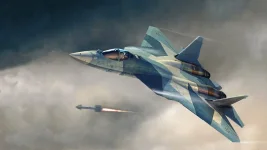
While Washington has formally offered the platform to New Delhi, a renewed US strategic tilt toward Pakistan, coupled with concerns over operational sovereignty, has prompted Indian defence planners to pivot interest toward Russia’s Su-57E.
This shift is increasingly viewed as a pragmatic "bridge" solution to secure air superiority until India’s indigenous Advanced Medium Combat Aircraft (AMCA) becomes operational in the mid-2030s.
The Pakistan Factor: A Trust Deficit
The initial momentum for the F-35 deal, sparked by President Donald Trump’s offer during Prime Minister Narendra Modi’s visit to the White House in February 2025, has been severely dampened by subsequent US foreign policy moves.Despite an "America First" rhetoric that initially froze foreign aid, the Trump administration authorized a $450 million sustainment package for Pakistan’s F-16 fleet in March 2025.
Although Washington justified this aid as counter-terrorism support, officials in New Delhi view it as a "maverick powerplay" that undermines India’s security interests.
The optics of the US offering F-35s to India while simultaneously upgrading Pakistan’s F-16s—amidst the lingering scars of border tensions—have fuelled a perception of American hedging. Consequently, the trust required for a purchase as sensitive as the F-35 has eroded.
Note: Open-source intelligence indicates that the F-16 package typically includes technical support and engine modifications, capabilities that directly enhance the Pakistan Air Force's operational readiness against conventional threats, not just counter-terrorism.
Operational Sovereignty and the "Black Box" Dilemma
Beyond geopolitics, the Indian Air Force (IAF) harbours deep reservations regarding the F-35’s operational architecture.A senior Pentagon official recently admitted that the US views the jet not just as hardware, but as a node in a US-controlled network. While this allows for advanced interoperability with allied assets like the E-7 Wedgetail, it comes at a cost to autonomy.
The F-35 relies on a complex logistics and data system (often referred to as ALIS or ODIN in open-source discussions) that requires frequent data exchanges with US-based servers.
For India, this "black-box" architecture raises red flags:
- Activation Codes: The requirement for daily activation codes could theoretically allow the US to restrict the jet's use during a crisis.
- Maintenance Delays: A 2024 Pentagon report cited by sources highlighted average repair downtimes of 141 days, a logistical liability for a frontline force like the IAF.
- Sovereignty: India’s strategic doctrine prioritises absolute control over its nuclear-capable assets, a condition the F-35’s tethered nature struggles to meet.
The Russian Pivot: Su-57E as the Interim Powerhouse
With the F-35 deal in limbo, the Russian Su-57E has emerged as a viable alternative.Accelerated by President Vladimir Putin’s visit to Delhi in December 2025, talks are now focused on an initial flyaway batch of 40–60 jets, potentially scaling to 140 units manufactured domestically at Hindustan Aeronautics Limited’s (HAL) Nashik facility.
Unlike the American offer, the Russian proposal addresses India’s core demand for technology transfer (ToT) and customisation:
- Source Code Access: Russia has offered unrestricted access to the aircraft’s source code, allowing India to integrate its own weapons, such as the Astra air-to-air missile.
- Strategic Autonomy: The deal promises comprehensive indigenisation, including the production of the advanced AL-51F1 engine, which could also upgrade the IAF’s existing Su-30MKI fleet.
- Gap Filler: The Su-57E is positioned to fill the critical squadron shortage left by retiring MiG-21s, serving as a high-capability stopgap until the indigenous AMCA is ready.
The Ultimate Goal: AMCA
Defence experts emphasise that the shift to the Su-57E does not signal an abandonment of self-reliance.On the contrary, it buys time for the Advanced Medium Combat Aircraft (AMCA), India’s indigenous fifth-generation fighter project. Greenlit in May 2025, the AMCA prototype is expected to fly by 2030, with induction slated for the mid-2030s.
The Su-57E provides a "practical bridge," ensuring the IAF maintains a technological edge over regional rivals—specifically countering the Chinese J-20—without becoming dependent on a US ecosystem that currently appears strategically volatile.
While US-India defence ties remain "stronger than ever" on paper—reaffirmed by the Defense Framework signed in Kuala Lumpur in October 2025—the practical reality of procurement suggests a return to a diversified "multi-vendor" strategy.
India appears determined to hedge against US leverage while securing the immediate firepower it needs.