- Views: 2K
- Replies: 4
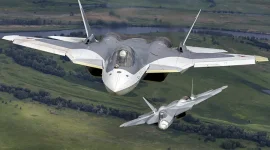
The recent maiden flight of Russia’s first twin-seat fifth-generation stealth fighter, the Su-57D, has brought renewed attention to India’s possible involvement in the advanced aircraft program.
Following the jet's inaugural flight on May 19, Sergey Bogdan, the chief test pilot, stated that the two-seater model was specifically engineered to attract international buyers, particularly air forces transitioning to Sukhoi combat jets for the first time.
Bogdan explained that comprehensive pilot training is a critical factor for foreign operators.
While militaries familiar with older platforms like the Su-27, Su-30, and Su-35 face a relatively smooth transition, nations without prior Sukhoi experience need a purpose-built training platform.
The new twin-seat design meets this exact requirement, significantly boosting the fighter's export viability.
Moscow has openly tied the development of the two-pilot Su-57 to international demand.
As far back as late 2020 and mid-2021, senior Russian officials confirmed that foreign interest was the primary catalyst for the twin-seat variant.
Global aerospace observers have long pointed to India as the primary driving force behind this specific configuration.
The Indian Air Force (IAF) has traditionally favoured two-crew fighters, as demonstrated by its massive fleet of over 250 Su-30MKI jets.
A second crew member is highly valued by the IAF for managing complex electronic warfare, coordinating long-range strikes, and handling modern network-centric battlefield operations.
Bilateral talks regarding the Su-57 have accelerated considerably over the last couple of years.
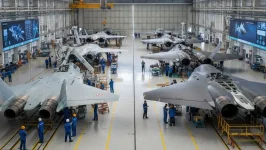
By early 2025, reports surfaced that New Delhi and Moscow were actively exploring a licensed manufacturing agreement.
Most notably, in a significant departure from standard Russian export policies, Moscow reportedly offered India unprecedented access to the Su-57’s sensitive source codes in mid-2025.
This is a monumental development in the bilateral defence relationship.
India had previously withdrawn from the joint Fifth Generation Fighter Aircraft (FGFA) project in 2018, largely due to concerns over restricted technology transfer and denied access to these exact computer source codes.
By offering full transparency now, Russia is demonstrating a strong commitment to securing India as a major partner.
By January 2026, the Indian Ministry of Defence confirmed that these negotiations had moved past initial assessments and into advanced technical stages.
Defence experts suggest New Delhi is weighing three primary strategies for acquiring the stealth aircraft.
The quickest solution would be a direct purchase of fully assembled Russian fighters to urgently address the IAF's declining squadron numbers.
A second alternative is standard licensed production within India, which would build domestic manufacturing capabilities while keeping the aircraft largely identical to Russian-operated versions.
The third, and most strategic, option is the joint development of a deeply customised Indian variant under the "Make in India" initiative.
Utilising the new twin-seat Su-57D airframe, this heavily modified fighter could be equipped with indigenous Indian avionics, advanced mission computers, secured communication systems, and homegrown smart weapons like the Astra air-to-air missile series.
This route aligns perfectly with India's broader goals of technological self-reliance while still leveraging foreign aerodynamic breakthroughs.
Procuring a customised Su-57 could provide the IAF with a crucial interim fifth-generation capability.
With India’s domestically developed Advanced Medium Combat Aircraft (AMCA) not projected to enter active service until the mid-2030s, the Russian stealth fighter would fill an immediate tactical gap.
Furthermore, the advanced manufacturing experience and high-end technology transfer gained from a Su-57 licensed production deal would likely provide massive, direct benefits to India's own future aerospace defence projects.