- Views: 4K
- Replies: 9
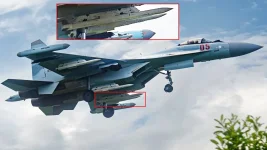
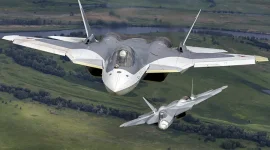
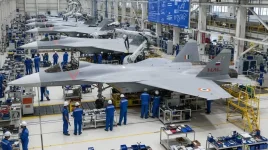
Russia has significantly intensified its efforts to market the Su-57E stealth fighter to India, presenting the aircraft not merely as an immediate purchase but as a long-term strategic platform capable of remaining relevant for half a century.
Vadim Badekha, the Chief Executive Officer of United Aircraft Corporation (UAC), has formally articulated that the Su-57E is uniquely positioned to satisfy the Indian Air Force’s (IAF) future combat needs.
He emphasised that the aircraft boasts a robust design life of 40 to 50 years, ensuring it can withstand decades of operational service while adapting to the rapidly changing technological landscape of modern aerial warfare.
Built for Adaptation and Longevity
According to the UAC chief, the Su-57E’s primary advantage lies in its open architecture.While the jet delivers all standard fifth-generation capabilities—such as low observability (stealth), sensor fusion, and advanced avionics—its internal systems are designed to be modular.
This allows for the integration of new weapons and sensors without requiring fundamental structural changes to the airframe.
This "plug-and-play" philosophy is intended to reduce the substantial costs typically associated with mid-life upgrade programmes, allowing the user to keep the fighter technologically current with relative ease.
In recent discussions reported around the December 2025 India-Russia summit, Russian officials have even offered India access to the aircraft's source code.
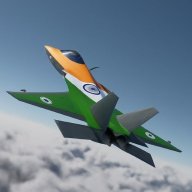
This unprecedented level of technology transfer would theoretically allow Indian state-owned enterprises, such as Hindustan Aeronautics Limited (HAL), to integrate indigenous weapons like the Astra air-to-air missile independently.
A Bridge to Sixth-Generation Warfare
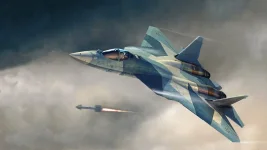
Mr Badekha further highlighted that the Su-57 is effectively serving as a flying testbed for next-generation technologies.Rather than waiting for a completely new "sixth-generation" aircraft design to mature, Russia is using the Su-57 to field-test advanced sensors, electronic warfare (EW) suites, and next-generation propulsion systems today.
The argument presented to Indian officials is that the Su-57 will evolve incrementally, eventually incorporating features currently associated with sixth-generation concepts, such as directed energy weapons and hypersonic capabilities.
Manned-Unmanned Teaming (MUMT)
A critical pillar of this pitch involves the integration of Artificial Intelligence (AI) and drone warfare. Badekha described the Su-57 as a future "command-and-control hub" designed to lead formation of unmanned systems.In this Manned-Unmanned Teaming (MUMT) role, the pilot would act as a mission commander, directing a swarm of accompanying drones to conduct dangerous tasks such as reconnaissance, jamming, or penetrating strikes.
This capability directly references Russia's development of the S-70 Okhotnik-B (Hunter) heavy stealth drone. The S-70 is designed to operate as a "loyal wingman" alongside the Su-57, extending the fighter's sensor reach and strike range while keeping the manned aircraft out of immediate danger from enemy air defences.
Strategic Implications for the IAF
By framing the Su-57E as a scalable platform that bridges the gap between fifth and sixth-generation technologies, UAC is targeting the IAF’s requirement for sustainable air power well into the 2060s.With the indigenous Advanced Medium Combat Aircraft (AMCA) still in development and the Multi-Role Fighter Aircraft (MRFA) tender process ongoing, Russia contends that the Su-57E offers a readily available solution that guarantees technological continuity and sovereignty for the Indian defence sector.