Recent satellite imagery analysis indicates that India’s ambitious fifth-generation fighter jet project, the Advanced Medium Combat Aircraft (AMCA), has been undergoing rigorous radar testing.
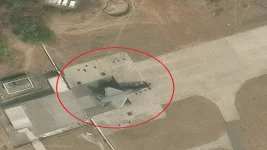
A full-scale engineering model of the aircraft has been visible at a specialised Radar Cross Section (RCS) testing facility since May 2026, marking a significant milestone in the platform's developmental journey.
Often called an “iron bird,” this ground-testing model was seen stationed at the ORANGE RCS facility. This specific site is tailored to measure the radar signature of military hardware.
Conducting these evaluations on the ground is an essential phase to ensure the aircraft's stealth capabilities are fully refined before a working prototype is cleared for flight trials.
A striking detail from the overhead images is a radar system positioned roughly one kilometre from the AMCA model. This specific distance aligns perfectly with standard measurement geometry for radar cross-section evaluations.
In such setups, engineers use a transmitter and receiver at a controlled distance to bounce signals off the target, carefully analysing the reflections to determine how "visible" the aircraft would be to enemy forces.
Although it is impossible to definitively identify the exact radar from space, experts believe the system in use is a Very High Frequency (VHF) anti-stealth radar.
The two most likely candidates are the indigenous Surya VHF radar or the DRDO-BEL VHF-SR (Very High Frequency Surveillance Radar).
Open-source data reveals that the Surya VHF radar, developed by Bengaluru-based Alpha Design Technologies and inducted into the Indian Air Force in 2025, is a mobile 3D radar specifically designed to track low-observable targets at ranges up to 360 kilometres.
Similarly, the DRDO-BEL VHF-SR utilises Active Electronically Scanned Array (AESA) technology and long wavelengths to hunt stealth aircraft at ranges exceeding 300 kilometres.
Testing the AMCA against these low-frequency VHF systems is a crucial step for modern combat aircraft.
While fifth-generation fighters are expertly shaped to evade high-frequency targeting radars, their radar-absorbing materials and contours can sometimes be detected by longer-wavelength VHF systems.
By exposing the AMCA to these anti-stealth radars early in the design phase, engineers can map its vulnerabilities and tweak the aircraft's shaping to ensure comprehensive invisibility across all radar bands.
It should be noted that the "iron bird" currently being tested does not necessarily represent the final look of the AMCA.
Fighter jet designs naturally undergo numerous modifications during their creation.
These engineering mock-ups serve as a physical proving ground to validate aerodynamic layouts, internal system integration, and stealth profiles before an actual flying prototype is manufactured.
Finally, these conclusions are drawn entirely from the independent analysis of satellite photographs.
Neither the Defence Research and Development Organisation (DRDO) nor the Aeronautical Development Agency (ADA) has issued official statements confirming these RCS tests or naming the specific radar systems involved.
Therefore, the involvement of advanced systems like the Surya VHF or the DRDO-BEL VHF-SR remains a highly informed deduction rather than officially verified fact.