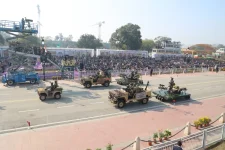
Tata Advanced Systems Limited (TASL) has quietly introduced its latest 8×8 Wheeled Infantry Combat Vehicle (WhICV), a platform that signals a significant departure from its predecessor, the Wheeled Armoured Platform (WhAP).
While the two vehicles may share a visual lineage, the WhICV is not merely a cosmetic update; it represents a comprehensive re-engineering effort aimed specifically at meeting the rigorous demands of the Indian Army’s future mechanised infantry.
The design choices reveal a clear focus on survivability and the practical realities of modern battlefield environments.
A primary structural evolution in the WhICV is the implementation of a redesigned V-hull.
In contrast to earlier models, this hull geometry has been specifically optimised to deflect the blast energy from mines and improvised explosive devices (IEDs) more effectively. This modification directly addresses the Army’s consistent requirement for superior underbody protection.
The structural enhancements are complemented by a revised internal layout and armour shaping, indicating that the safety of the crew has been placed above simple payload capacity.
Despite remaining within the 25-tonne weight category, the WhICV is expected to offer substantially higher protection levels than the WhAP.
This achievement suggests that TASL has utilised advanced armour integration techniques and improved mass distribution rather than merely adding bulk.
Consequently, the vehicle is likely to provide robust protection while retaining the necessary margin for future payload upgrades and system additions without compromising its mobility.
The vehicle also features increased ground clearance, a subtle yet vital improvement for operations across difficult terrain.
This elevated stance enhances cross-country performance and serves as a critical defensive measure by increasing the standoff distance between the vehicle floor and potential ground-based explosions.
When combined with the new V-hull, this design significantly mitigates the impact of blasts on the crew compartment.
Inside the vehicle, the layout reflects a notable shift in doctrinal thinking. The driver’s station has been relocated to the right-hand side, a configuration that mirrors the Indian Protected Mobility Vehicle (IPMV).
This standardisation is intentional, designed to simplify driver training and align with the ergonomic preferences of the Indian Army.
Furthermore, the engine has been moved to the left side, a change that betters the vehicle's balance and creates additional volume for troop accommodation and the integration of mission systems.
A key element of the WhICV’s design is the incorporation of an indigenous turret.
This move serves a practical purpose beyond national pride; a domestically designed turret facilitates the seamless integration of local weapon systems, sensors, and fire-control units.
It also ensures that the platform remains free from the intellectual property constraints and export restrictions often associated with foreign components.
The propulsion system further emphasises the drive for self-reliance, utilising an indigenised MTU-based engine solution.
This reduces dependence on imported drivetrains and ensures that the powerpack is tailored to the specific weight and agility requirements of the platform.
Moreover, a locally supported engine ecosystem significantly enhances lifecycle sustainment, ensuring higher readiness rates for the armoured fleet over the long term.
Collectively, these modifications indicate that the WhICV is a response to a distinct operational philosophy.
While the original WhAP was designed as a lighter, amphibious solution, the WhICV is evidently built for high-threat environments where protected mobility is paramount. Its architecture prioritises survivability, modular armour, and the integration of Indian-made subsystems.
This development comes at a time when TASL has already demonstrated the maturity of its wheeled platforms, evidenced by the recent export success of the WhAP to the Royal Moroccan Army, further validating the global competitiveness of Indian defence manufacturing.
If the vehicle’s performance matches its design specifications, the WhICV could establish a new standard for India’s wheeled combat fleet.
It promises to deliver enhanced protection, improved ergonomics, and greater indigenisation without exceeding the weight limits of its class.
Ultimately, the WhICV demonstrates that the Indian defence industry is transitioning from adapting foreign designs to creating bespoke combat architectures suited to India’s specific operational needs.