- Views: 2K
- Replies: 11
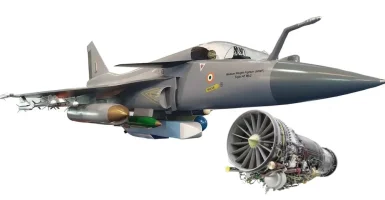
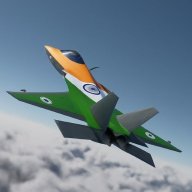
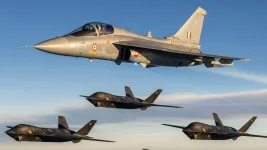
India’s forthcoming medium-weight combat aircraft, the HAL Tejas Mk2, is undergoing significant aerodynamic refinements to elevate its reach and battlefield performance.
Among the most prominent upgrades is the introduction of "pinched waist" external fuel tanks.
Rooted in advanced aerodynamic principles, this distinct design actively curtails drag at elevated velocities, representing a substantial evolution from the conventional drop tanks utilised on older Tejas models.
This allows the fighter to sustain higher speeds, extended flight times, and a broader operational radius while carrying a substantial fuel payload.
The Science Behind the 'Pinched Waist'
The term describes the unique silhouette of these new tanks. Rather than a standard, uniform cylindrical shape, these drop tanks are contoured with a narrowed midsection, resembling an hourglass.This geometry is directly informed by the "area rule," a critical aerospace engineering concept used to minimise wave drag as an aircraft nears the speed of sound.
Standard cylindrical tanks often disrupt airflow over the wings, generating significant interference drag during transonic and supersonic flight.
By tapering the centre, the pinched waist configuration facilitates smoother airflow, significantly mitigating the aerodynamic penalties usually caused by external stores.
Retaining Fuel During High-Speed Intercepts
Historically, fighter pilots have had to jettison external fuel tanks before engaging in high-speed dashes because the resultant drag would otherwise hinder performance.However, the aerodynamically optimised tanks on the Tejas Mk2 are engineered to remain stable and efficient during transonic and low-supersonic operations.
Consequently, the aircraft can execute rapid, high-speed manoeuvres without the immediate need to discard its fuel reserves, thereby prolonging its high-velocity reach.
Massive Expansion in Fuel Capacity and Endurance
Beyond shape, the sheer volume of fuel the Tejas Mk2 can carry has seen a massive upgrade.The fighter's standard long-range loadout is projected to feature:
- Two 1,800-litre pinched waist tanks on the inboard wing pylons.
- One 1,300-litre supersonic tank on the centreline station.
This immense capacity enables the Tejas Mk2 to conduct Combat Air Patrols (CAP) for up to 3.5 hours without requiring mid-air refuelling.
This is a vital enhancement for the Indian Air Force, ensuring persistent surveillance and defence over strategic or sensitive airspace.
Doubling the Ferry Range
This surge in fuel capacity directly translates to a striking increase in operational reach.While the earlier Tejas Mk1 and Mk1A variants—which relied on less aerodynamically efficient 1,200-litre tanks—were limited to a ferry range of around 1,700 kilometres, the Tejas Mk2 is projected to exceed a ferry range of 3,500 kilometres.
Designed by the Aeronautical Development Agency (ADA) and manufactured by Hindustan Aeronautics Limited (HAL), the new 17.5-tonne Tejas Mk2 will be powered by a robust General Electric F414-INS6 engine.
With its doubled range, heavier payload capacity, and cutting-edge avionics, the Mk2 is poised to become a formidable long-range multirole platform, well-equipped for air superiority, maritime strike, and deep-penetration missions.