- Views: 5K
- Replies: 12
India’s indigenous Uttam Active Electronically Scanned Array (AESA) radar is establishing itself as a premier airborne sensor on the global stage.
Senior defence officials have confirmed that the system has not only matched but, in several critical performance metrics, exceeded the capabilities of some of the most renowned AESA radars currently operational worldwide.
Director General of Electronics and Communication Systems at DRDO, Mr B.K. Das, stated that India has firmly established a self-reliant ecosystem for radar development, eliminating the need to rely on international vendors for frontline fighter sensors.
Commenting on the advancements in indigenous avionics, he noted, “We are developing our radar. The Uttam AESA radar has proven to be among the best, and in many aspects better than the best across the world.”
Superior Performance Metrics
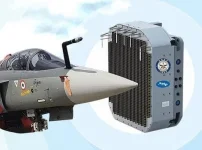
The Uttam AESA radar, developed by the Electronics and Radar Development Establishment (LRDE), has undergone rigorous flight testing and operational validation on the Tejas Mk1A platform.Comparative trials have reportedly shown the indigenous sensor outperforming the Israeli-origin ELM-2052 AESA radar—which equipped earlier Tejas variants—across multiple parameters.
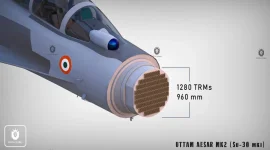
Open-source intelligence indicates that the Uttam radar, equipped with approximately 912 to 980 solid-state Transmit/Receive Modules (TRMs), offers a distinct advantage over competitors with lower TRM density.
While the ELM-2052 is capable of tracking 64 targets, the Uttam radar is reported to track over 100 targets simultaneously.
Furthermore, in detection range tests, the Uttam has demonstrated the ability to detect fighter-sized targets at ranges exceeding 140 kilometres, surpassing the effective range of comparable foreign systems in similar modes.
Equipping the Future Fleet
In a major vote of confidence for the system’s maturity, Hindustan Aeronautics Limited (HAL) has finalised plans to fit the Uttam AESA radar on the forthcoming second batch of 97 Tejas Mk1A fighters.This substantial order, placed by the Indian Air Force, is expected to see deliveries commence between 2028 and 2029.
This transition marks a pivotal shift towards a completely indigenous sensor and weapon configuration for India’s primary light combat aircraft.
Integrated Combat Capabilities
Mr Das also highlighted the wider strides made in indigenous electronic warfare (EW) and weaponry.The Uttam radar is now set for full integration with a suite of domestic technologies, including advanced jammers and air-to-air missiles like the Astra series.
This unified combat suite is projected to drastically improve the Tejas Mk1A’s survivability, situational awareness, and overall lethality in contested airspaces.
The radar boasts a modular architecture that supports simultaneous air-to-air and air-to-ground modes, high-resolution synthetic aperture radar (SAR) mapping, and robust electronic protection measures.
Its scalable design ensures it can be adapted for future platforms, such as the Tejas Mk2 and the fifth-generation Advanced Medium Combat Aircraft (AMCA), with plans already underway to upgrade the technology from Gallium Arsenide (GaAs) to even more efficient Gallium Nitride (GaN) modules.
Achieving Sensor Sovereignty
For the Indian Air Force, the operationalisation of the Uttam AESA represents a significant leap towards sensor sovereignty.In an era where air combat is defined by information superiority, control over radar technology is as vital as the aircraft’s engine or airframe.
Possessing a homegrown AESA radar grants India full autonomy over critical upgrades, the management of threat libraries, and the integration of electronic warfare protocols, free from the restrictions of foreign export control regimes.