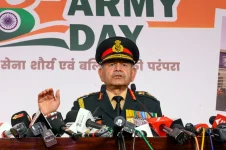
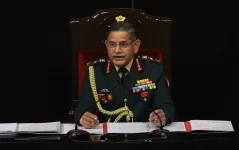
A “three-dimensional chess” was being played during Operation Sindoor, when the Indian forces were fully prepared for multiple actions to “dominate” the complete escalation ladder, Army Chief Gen Upendra Dwivedi said on Thursday.
In his address at the launch of the book, ‘Redlines Redrawn – Operation Sindoor and India’s New Normal’ here, he also said the information domain saw a “series of coordinated actions, well planned and put into place, even before the first weapon was fired.
“‘Op Sindoor’… was given to me, if I remember, on 29th or 30th of April. But it was not put out in the media”, he added, without elaborating.
“And as you are aware that the tweet — ‘Justice is served’ had huge record hits on Twitter (now X). Today as we speak, it’s nearly 23 million. The IW (info-warfare) was credible, consistent, and to a plan, which was unveiled in a sequential manner,” the General said.
Operation Sindoor was carried out by the Indian armed forces in the early hours of May 7 last year, eliminating at least 100 terrorists in response to the horrific Pahalgam terror attack of April that killed 26 innocent civilians.
“#PahalgamTerrorAttack Justice is Served. Jai Hind!” the Indian Army had posted on X at 1:51 am on May 7, shortly after the operation was launched.At the event, referring to the operation, he said, in the military domain, “we all know of the actions and reactions on both sides”.
“A three-dimensional chess was being played, where we had war-gamed our actions in-house with our red teams, and were fully prepared for multiple actions to dominate the complete escalation ladder,” the Army chief said.Operation Sindoor also showed that the jointness is “no longer something we aspire” to do in seminars or discussions, he underlined.
“It is something we practised under pressure and we came out as a successful synergistic organisation,” the General said.
He said tactical ups and downs would happen during the conduct. However, a “wholesome positive end-state based on initial aims is what segregates a very successful mission from a not-so-successful one. And I can say proudly, Op Sindoor was the most successful operation”, the General added.The Army chief further said the “old assumption” that India requires a “long time for decision-making”, as also a long drawn mobilisation cycle to synchronise force application, was “quietly etched out of the window”.
“And one could say that the adversary discovered that India’s decision-making loop has become shorter, while there’s become longer and incoherent,” he added.
The same was true for pre-positioning and calibrated mobilisation of the ground forces, the general said.
The economic domain saw a slew of actions by the government which “enabled us before, during and even after the operations”.
“However, we have to be careful, with our supply chains and built-in resilience through Atmanirbharta, which is the only solution for the long run. Dynamic response system may be a heavy response system next time. From a short-duration war, it may be a heavy long-duration war,” he said.
Gen Dwivedi asserted that there was “the troika of academia, industry and military”, which was “truly synergised” in all manners.
Equipment was provided to the force and they said not to worry about the cost, “we will discuss after Op Sindoor”, he said.
Together these perspectives in DIME (diplomatic, informational, military, and economic), reflect the reality that “modern conflict is no longer confined to in a single domain. It’s simultaneous, integrated and continuous, basically a whole-of-nation approach”, he said.So apart from Operation Sindoor, the book also covers the entire arc from 1989 to Uri and Balakot judiciously. From assumed restraint to calibrated response to the present phase where responses are “dynamic, domain-agnostic and no longer predictable”, the General said.
“We are no longer debating whether to respond, but how to shape responses without being boxed into pre-declared templates,” he said.
Earlier in his address, he also took note of the multi-party delegations which were sent to various countries by India after the military action to convey to them the country’s stand of “zero tolerance for terrorism”.
“More importantly, visits by all-party delegations to various countries on Operation Sindoor vindicated the responsibility with which India conceptualised, conducted, calibrated and communicated about operation,” the Army chief said.
On information warfare, he said, there were actions in this domain, from both sides, “but the winner in the long run was the one whose narrative was based on truth and backed with credible evidence”.
“As they say, seeing is believing, and the world saw on their TV screens how the nine targets were destroyed in a synergistic manner, that all three forces were involved in it through 22 minutes of precision, non-escalatory strikes, and of course, followed by images, later on, of the damaged airfields or equipment on ground,” he said.