- Views: 2K
- Replies: 2
As India pushes forward with its homegrown aviation programs, there is often confusion regarding how the forthcoming Tejas Mk2 relates to the Advanced Medium Combat Aircraft (AMCA) program.
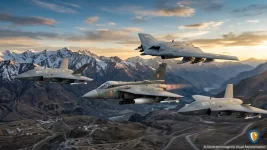
It is crucial to understand that these two fighter jets are built for entirely distinct operational roles. The Tejas Mk2 functions as a 4.5-generation Medium Weight Fighter (MWF), whereas the AMCA is envisioned to be India’s inaugural fifth-generation stealth combat aircraft.
Rather than seeing these platforms as rivals competing for resources, the Tejas Mk2 must be understood as an essential bridge.
It delivers the critical manufacturing and technical knowledge needed to successfully achieve the nation's advanced stealth goals.
Building Industrial Strength and Next-Generation Skills
Engineering a state-of-the-art military jet is a highly demanding endeavour. It requires an unbroken chain of research, testing, quality certification, and final production.No nation has ever bypassed the intermediate stages of combat aircraft development to directly leap from producing basic light fighters to manufacturing complex stealth jets.
Institutions like the Aeronautical Development Agency (ADA) and Hindustan Aeronautics Limited (HAL) are deliberately using the Tejas Mk2 project to master this necessary learning curve.
The Tejas Mk2 will be a significantly larger 17.5-tonne aircraft. It is being designed with an extended fuselage and close-coupled canards (small forward wings) that dramatically enhance the jet's agility in the air.
To power this heavier platform, the aircraft will utilize the General Electric F414-INS6 engine. This engine will be manufactured in India through a major technology transfer pact signed between GE Aerospace and HAL, allowing for 80% domestic production of the engine components.
Built with 11 external hardpoints, the jet can carry a massive weapon payload of 6.5 tonnes, and it will be packed with cutting-edge indigenous systems.
Open-source reports confirms it will integrate long-range weapons like the Astra air-to-air missile and the BrahMos-NG cruise missile.
Among its primary sensors will be the highly capable domestic Uttam Active Electronically Scanned Array (AESA) radar, a new Infrared Search and Track (IRST) system, and a Dual Colour Missile Approach Warning System (DCMAWS) to detect incoming threats.
Once it enters serial production by the end of the decade, the Tejas Mk2 will become the backbone of the Indian Air Force. It is specifically slated to replace the rapidly retiring fleets of French Mirage 2000s, British SEPECAT Jaguars, and Russian MiG-29s.
Expanding the Domestic Defence Network
Beyond simply delivering a new jet, the MWF program is laying the groundwork for a much larger, self-reliant defence manufacturing ecosystem across the country.Each subsystem integrated into the new fighter—ranging from the Unified Electronic Warfare Suite (UEWS) to smart munitions—creates business opportunities for a vast network of local suppliers.
Hundreds of Indian companies from both the public and private sectors are now part of this aerospace supply chain.
This collaborative effort strengthens the national industrial base and brings India closer to total self-sufficiency in defence production.
A Calculated Path to Stealth Superiority
The country’s military aviation roadmap relies on a disciplined, step-by-step strategy, where every program directly benefits from the achievements of the last:- Tejas Mk1 and Mk1A: These early iterations laid the initial groundwork for building supersonic fighters at home. The Indian Air Force has ordered a large number of the Mk1A models to quickly rebuild its depleting combat squadrons.
- Tejas Mk2: Formally cleared for development by the Cabinet Committee on Security in 2022 at a cost of ₹10,000 crore, this project takes the base design and upgrades it. It provides Indian engineers and manufacturers hands-on experience with heavier aircraft frames, complex sensor fusion, and superior avionics. The first prototype is actively being built and is expected to conduct its first flight between late 2025 and mid-2026.
- AMCA: With government funding officially sanctioned in early 2024, the fifth-generation program will absorb all the advanced manufacturing techniques and design lessons acquired during the Mk2 phase. The AMCA is targeted for rollout by the end of 2028 and will securely position India among elite nations capable of producing stealth jets.
Instead, it is the fundamental driving force that is building the robust aerospace infrastructure required to successfully deliver and sustain India’s future stealth fleet.