- Views: 5K
- Replies: 15
A central criticism of India’s current combat aviation roadmap is both stark and justifiable: the Indian Air Force is still waiting for substantial Tejas Mk1A deliveries, and the next-generation Tejas Mk2 has yet to take to the skies.
This delay has caused significant disappointment within the strategic community. Had the Mk1A been inducted on time and the Mk2 programme accelerated, they would have served as a robust alternative to the costly import of Medium Role Fighter Aircraft (MRFA).
Instead, these schedule slippages have inadvertently strengthened the case for foreign vendors and weakened the argument for an indigenous fighter roadmap.
The Problem of Optimistic Messaging
A fundamental issue lies in how expectations are managed. The Aeronautical Development Agency (ADA) and Hindustan Aeronautics Limited (HAL) often publicise "best-case" timelines, which rarely materialise in the complex world of aerospace engineering.When an Indian defence programme claims it will take five years from contract to delivery, any delay is often branded as incompetence.
Conversely, when foreign manufacturers propose similar timelines, the inevitable delays are accepted as standard industrial practice. This double standard harms the credibility of domestic projects.
The Reality Behind Mk1A Delays
The stalling of the Tejas Mk1A programme can be attributed to two primary factors: airframe production capacity and engine supply.1. Airframe Production
Historically a bottleneck, airframe manufacturing has largely been addressed.HAL has now surpassed the production rate of 16 airframes per year and is aggressively building up its inventory.
Crucially, the company made the strategic decision not to halt assembly despite the lack of engines.
By continuing to manufacture airframes, HAL protects its extensive supplier base.
If production were to stop, smaller vendors would face financial collapse, damaging the entire ecosystem essential for future aircraft projects.
Once engines arrive, installing them and completing factory testing takes approximately two weeks, allowing for rapid handover of completed jets.
Recent developments support this progress.
In October 2025, a new third production line was inaugurated at HAL's Nashik facility to boost capacity to 24 aircraft annually, with plans for a fourth line to reach 30 units per year.
2. The Engine Crisis
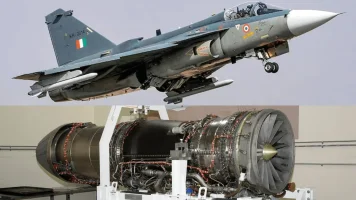
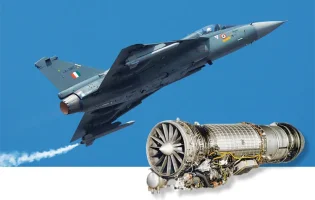
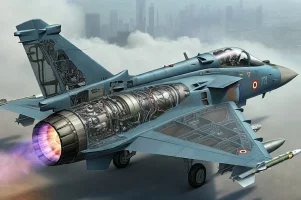
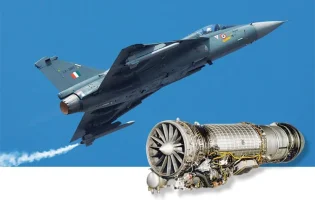
The more significant obstacle has been the delay in F404 engines from the United States.This highlights a broader strategic vulnerability: India’s dependence on US-origin propulsion extends across fighters, transport aircraft, helicopters, and naval warships.
However, the situation is improving. Engine deliveries from GE Aerospace resumed in late 2025, with a steady stream expected throughout 2026.
This has allowed HAL to begin clearing the backlog of airframes sitting in its hangars.
Weapon Integration Success
While production faced hurdles, certification and weapon integration have progressed rapidly.The Tejas Mk1A is being certified to carry a formidable array of weaponry.
This includes the complete weapons package from the Rafale deal (paid for under India-Specific Enhancements) and the full family of Israeli air-to-ground munitions.
Significant milestones have already been achieved:
- Astra Missile: Integration of this indigenous Beyond Visual Range (BVR) missile is complete.
- ASRAAM: The Advanced Short Range Air-to-Air Missile has undergone successful firing trials and is integrated on the dual pylon.
- Electronic Warfare: The integration of the ASPJ (Advanced Self Protection Jammer) is finished. The aircraft currently operates with an Elta radar and pod combination, while the indigenous Uttam AESA radar paired with DRDO’s own pod—which has demonstrated superior performance—is undergoing intense flight testing.
Tejas Mk2: A New Industrial Philosophy
The story of the Tejas Mk2 differs significantly from its predecessor.While HAL manages the Mk1A, the ADA is the lead designer for the Mk2, which has been engineered from the start for "distributed manufacturing."
For the Mk1A, most sub-assemblies are structural, leaving the time-consuming tasks of wiring and plumbing to be done at HAL’s final assembly line. The Mk2 flips this model. Suppliers will now deliver sub-assemblies that are already internally wired and plumbed.
This shift transfers a massive workload from HAL to private vendors, theoretically allowing for much faster assembly times once suppliers adapt to the new standards. It is a first for India’s aerospace sector and forces the entire ecosystem to upskill.
Contrary to rumours, the Mk2 does not rely on "Rafale technology." It is a distinct indigenous design. While ADA and DRDO leadership have faced criticism for ambitious timelines, HAL’s internal projections have remained more conservative.
The first prototype rollout was confirmed for late 2025, with a maiden flight targeted for mid-2026.
Conclusion
The Tejas programme is often judged solely on delivery numbers, but its true value lies in industrial capacity building. HAL is currently absorbing criticism for delays that are partly due to a private sector still learning to build military-grade hardware at scale.This friction is a natural part of maturing as an aerospace power. The Tejas is merely the tip of the spear; the real achievement is the construction of the industrial machinery capable of forging that spear.