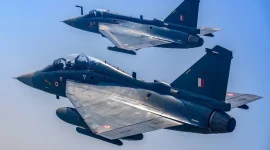
As India’s ambitious 114-jet Multi-Role Fighter Aircraft (MRFA) programme moves closer to finalisation, the Indian Air Force (IAF) is preparing for a significant technological leap.
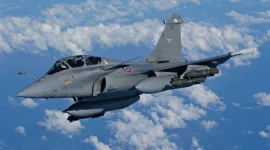
While the current fleet of 36 Rafale jets has already established air superiority, the proposed induction of the Rafale F4 standard promises to revolutionise the IAF’s combat potential.
Recent reports indicate that the Defence Procurement Board has cleared the proposal for these additional fighters, positioning the Rafale F4 as the definitive "bridge" solution for India’s air defence needs until the indigenous Advanced Medium Combat Aircraft (AMCA) becomes operational, projected for the 2034-35 timeframe.
Beyond the F3R: A Generational Shift
The IAF currently operates the F3R standard, a formidable 4.5-generation platform.However, the incoming F4 variant is designed not merely as an upgrade, but as a hyper-connected, data-centric asset tailored for the complexities of modern multi-domain warfare.
This new standard transitions the aircraft from a standalone fighter into a networked node within a broader "combat cloud," capable of seamless interaction with land, sea, and air assets.
Seeing Everything: Advanced Radar and Sensors
One of the most critical enhancements in the F4 standard is the evolution of its sensor suite.While the F3R utilises the RBE2 active electronically scanned array (AESA) radar for effective air-to-air and air-to-ground engagement, the F4 takes this further.
The upgraded radar incorporates Ground Moving Target Indicator (GMTI) and Synthetic Aperture Radar (SAR) modes.
These additions grant pilots the ability to generate high-definition maps of the battlefield in real-time, regardless of weather conditions, and track moving ground vehicles with pinpoint accuracy.
This capability significantly bolsters the IAF's surveillance and deep-strike potential, ensuring no target remains hidden.
The "Collaborative Combat" Network
The defining feature of the Rafale F4 is connectivity.Current iterations rely on standard Link-16 data links; however, the F4 introduces "collaborative combat" capabilities powered by the new Thales CONTACT software-defined radio and secured high-speed satellite communications.
This architecture allows the F4 to share tactical data instantly with other aircraft, drones, and command centres.
By creating a unified picture of the battlespace, the F4 ensures that a pilot is never fighting in isolation but is supported by a distributed network of sensors and shooters.
A Digital Cockpit Revolution
Inside the cockpit, the pilot’s interface is undergoing a major overhaul. The existing Elbit Dash IV helmet-mounted display used in the F3R fleet will be succeeded by the Thales Scorpion helmet-mounted display (HMD).The Scorpion HMD features a full-colour display and digital symbology that overlays flight and mission data directly onto the pilot's field of view.
By utilising advanced hybrid tracking technology, it allows pilots to cue weapons and sensors simply by looking at a target, drastically reducing reaction times in high-pressure combat scenarios.
Enhanced Lethality: MICA NG and HAMMER
The F4 standard also expands the aircraft's arsenal. While the Meteor missile remains a staple for long-range engagements, the F4 integrates the MICA NG (Next Generation) missile.This new weapon features a dual-pulse rocket motor for extended range and high manoeuvrability, alongside an AESA seeker that makes it incredibly difficult for stealthy targets to evade.
Furthermore, the integration of the 1,000 kg HAMMER precision-guided munition provides a heavy-strike capability previously unavailable on the platform.
This addition allows the IAF to engage hardened bunkers and fortified positions with extreme precision from stand-off distances.
AI-Driven Operations and Maintenance
Artificial Intelligence (AI) forms the backbone of the F4’s operational efficiency.Unlike the conventional sensor fusion of previous generations, the F4 uses onboard AI to manage the massive influx of data from radars, electronic warfare suites, and external sources.
This system filters noise to present only critical tactical information, preventing pilot overload.
Additionally, AI powers a new predictive maintenance system. By continuously monitoring the health of aircraft components, the system can forecast potential failures before they occur.
This "Prognosis and Diagnostic Aid System" is expected to increase fleet availability and reduce maintenance costs—a crucial factor for sustaining high-tempo operations.
Strategic Bridge to the Future
The Rafale F4 is optimised to counter advanced threats, including hostile stealth aircraft and dense air defence networks.For the IAF, this acquisition is strategic: it ensures India maintains a technological edge over regional adversaries for the next decade.
With the indigenous fifth-generation AMCA still in the development phase—with prototype rollouts expected around 2026-27 and full induction slated for the mid-2030s—the Rafale F4 will serve as the potent backbone of India’s frontline air defence, securing the skies during this critical transition period.