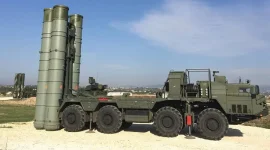
India is steadily closing the last remaining vulnerabilities in its western airspace as it prepares to receive its fourth S-400 Triumf air defence squadron by May 2026.
While the Indian Air Force (IAF) has already stationed two of its three active S-400 units—locally known as the "Sudarshan Chakra"—along the western front, a slight operational gap has persisted.
The integration of this upcoming fourth squadron will create an impenetrable shield along the border.
Procured under a landmark $5.43 billion agreement with Russia in 2018, this complete coverage will allow India to track and neutralise enemy aircraft hundreds of kilometres deep within Pakistani territory, ensuring comprehensive border security.
The formidable capabilities of this system were undeniable during the intense days of Operation Sindoor in May 2025.
Amidst the retaliatory strikes on Pakistan following the Pahalgam terror attack, the S-400 actively intercepted airborne threats.
Notably, on May 7, the IAF utilised the system to successfully shoot down a Pakistani JF-17 fighter aircraft operating well within its own airspace.
This decisive action forced other hostile jets to pull back, securing aerial dominance for India and cementing the S-400's reputation as a transformative asset in modern conflict.
During the May 2025 hostilities, military planners deployed two S-400 batteries to protect key western zones, preventing damage to crucial infrastructure.
However, the sheer scale of the frontline meant a slight vulnerability remained in the broader defensive network.
While the subsequent activation of the third system brought substantial improvements to areas like the northern borders and the Siliguri Corridor, it is the impending arrival of the fourth squadron that will ultimately provide near-absolute, end-to-end air defence across India's western boundary.
Although the delivery of the fourth unit faced delays of almost three years due to the logistical and production challenges stemming from the Russia-Ukraine conflict, its upcoming induction represents a massive leap for India's national security.
In an era where aerial threats range from stealth fighters to coordinated drone swarms, expanding the S-400 network is vital.
This advanced shield will serve as the backbone of India's strategy to maintain absolute air superiority and protect highly sensitive civilian and military assets.
Technologically, the Russian-built S-400 is a formidable powerhouse. Its highly sophisticated radar infrastructure can continuously track over 100 airborne objects simultaneously, allowing it to efficiently counter massive, coordinated enemy attacks.
Capable of firing interceptor missiles at speeds reaching Mach 14, the system boasts a firing rate roughly 2.5 times faster than the older S-300 model.
With the ability to engage targets at a staggering range of up to 400 kilometres, the expanded network will ensure India’s skies remain firmly protected against future threats.