- Views: 2K
- Replies: 3
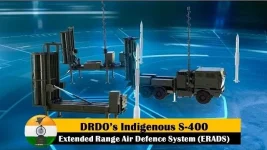
India's domestic long-range air defence initiative, Project Kusha—formally known as the Extended Range Air Defence System (ERADS)—is advancing into a crucial stage.
Following the Indian Air Force's (IAF) approval to acquire five squadrons for an estimated ₹21,700 crore (approximately $2.6 billion), the DRDO has pushed the programme from the drawing board into active testing and early manufacturing.
This marks a major leap toward creating a sovereign, multi-layered air defence shield for the nation.
In the early months of 2026, the DRDO successfully wrapped up the initial developmental flight tests for the system's M1 interceptor.
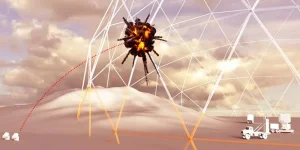
These tests validated critical propulsion systems, specifically the dual-pulse solid rocket motor. This motor gives the missile the necessary energy to outmanoeuvre and destroy highly agile targets during its final approach.
Having proven these core technologies, the M1 variant—capable of striking targets up to 150 kilometres away—is now scheduled for comprehensive integrated flight tests and user evaluations by late 2026.
At the same time, early manufacturing efforts are already in motion.
Public sector defence enterprises Bharat Electronics Limited (BEL) and Bharat Dynamics Limited (BDL) have begun building the initial batch of interceptor missiles and ground support equipment.
This strategy of overlapping testing with production highlights the military's urgent need for the system and demonstrates a strong belief in the reliability of the indigenous design.
Project Kusha is uniquely engineered as a three-layered missile shield to tackle diverse threats in the sky, boasting an impressive single-shot kill probability of over 80%.
The inner layer relies on the M1 missile (150 km range) to shoot down standard fighter jets, drones, and cruise missiles.
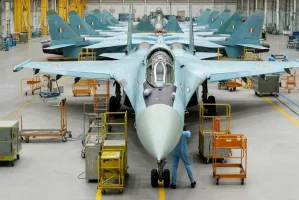
The middle layer uses the M2 interceptor, which has a 250 km reach and is specially equipped to hunt down stealth aircraft and faster threats, with its trials planned for 2027.
The outermost layer is defended by the M3 missile, a heavy interceptor capable of reaching between 350 and 400 kilometres to destroy large, high-value targets like enemy radar planes (AWACS) and mid-air refuelling tankers. Trials for the M3 are expected around 2028.
Operationally, the Kusha system relies on a highly modular and digitally connected network.
The heart of the system is the Multi-Function Control Radar (MFCR), which manages target tracking and firing, aided by low-level, mast-mounted surveillance radars.
All this data flows through a Command and Control Centre (CCC) directly linked to the IAF’s Integrated Air Command and Control System (IACCS).
This integration ensures seamless, real-time coordination across different military sensors and weapons.
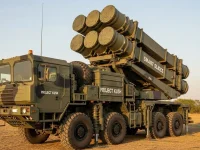
To ensure the system survives enemy attacks and can be deployed rapidly, it utilises various configurations of Mobile Launch Units (MLUs).
Furthermore, the addition of Battle Management Radars (BMR) allows the system to accurately track and engage multiple targets simultaneously, even in chaotic battlefield conditions.
Strategically, Project Kusha is envisioned to work alongside, and eventually supplement, imported platforms like the Russian S-400.
Notably, Kusha is significantly more cost-effective than foreign alternatives, offering comparable capabilities at a fraction of the cost of imported equivalents.
More importantly, it guarantees India absolute sovereignty over the system's software, sensor integration, and future upgrades.
Built to anticipate tomorrow's battlefields, its layered defence and advanced radar technologies will provide a robust, scalable barrier against modern threats, including drone saturation attacks and stealth technologies.