The Indian Ocean Region has become a theatre of intense strategic rivalry, prompting India to rapidly scale up its maritime intelligence and monitoring capabilities.
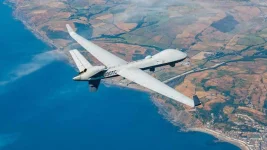
While advanced aerial assets like the MQ-9B SeaGuardian drone offer excellent high-altitude surveillance, they cannot single-handedly cover the entirety of this vast maritime expanse.
Spanning from the Strait of Hormuz to the Malacca Strait, the sheer magnitude of the Indian Ocean requires affordable, persistent surveillance platforms that can remain at sea for extended periods, paving the way for autonomous maritime vessels.
Recognising this gap, naval forces globally are pivoting towards Unmanned Surface Vessels (USVs) and Extra-Large Autonomous Underwater Vehicles (XLUUVs).
Aerial drones are inherently restricted by fuel capacity, flight time, and payload limits, whereas autonomous naval vessels can accommodate substantial sensor suites, operate continuously for weeks, and cover immense distances.
For the Indian Navy, introducing these ocean-going drones would act as a crucial force multiplier, effectively supplementing manned warships and aircraft while dramatically lowering the financial burden of patrolling the region.
The geography of the Indian Ocean, covering over 70 million square kilometres, includes some of the world's most critical maritime chokepoints and busiest sea lanes.
Relying exclusively on high-value combatants like destroyers and frigates for continuous monitoring across these transit routes is an inefficient use of resources.
Major naval ships are fundamentally built for deterrence, power projection, and combat, not monotonous, long-range patrol duties, making autonomous surface vessels an ideal, cost-effective substitute for routine monitoring.
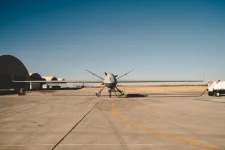
India's fleet of MQ-9B SeaGuardians boasts remarkable endurance of over 35 hours and carries sophisticated maritime radars and electro-optical systems.
However, airborne operations are bound by the laws of physics, consuming immense amounts of aviation fuel just to stay aloft and facing strict weight restrictions.
In contrast, waterborne drones do not need to generate lift, allowing them to carry significantly heavier equipment, larger fuel reserves, and high-powered communication systems without compromising aerodynamic performance.
Therefore, surface USVs are not meant to replace aerial drones, but to work alongside them, offering constant water-level tracking while aircraft provide rapid, wide-area intelligence.
A major benefit of long-range ocean drones is their ability to deploy massive sensor arrays that are simply too heavy or impractical for aircraft.
Modern anti-submarine warfare heavily relies on variable-depth sonars and lengthy towed acoustic arrays to track stealthy submarines over great distances.
Large USVs can easily tow these bulky systems continuously for weeks, relaying processed intelligence to naval headquarters via secure satellite links.
Similarly, future XLUUVs could silently patrol crucial underwater corridors using passive sonar, massively expanding situational awareness while reducing the reliance on costly, crewed anti-submarine patrols.
The most transformative operational aspect of unmanned maritime platforms is their unmatched endurance.
While aircraft rapidly burn fuel to maintain flight and manned ships require extensive logistical support, autonomous vessels cruising at low speeds consume minimal energy.
Equipped with diesel-electric propulsion, hybrid engines, or solar-assisted auxiliary power, these drones can remain deployed for months, creating a persistent surveillance network that closely monitors strategic maritime traffic without the need for frequent refuelling.
The Indian Navy constantly battles the logistical challenge of vast distances, managing security obligations from the Persian Gulf all the way to Southeast Asia.
Tasking heavily armed frigates with routine patrol operations accelerates wear and tear, consumes expensive fuel, and drains crew stamina.
Delegating these lower-risk surveillance tasks to autonomous vessels preserves the operational life of major warships, ensuring they remain fully primed for critical combat missions, carrier escort duties, and crisis response.
Modern naval strategy is transitioning away from relying on a few massive ships towards a distributed architecture of dispersed assets.
Deploying a vast network of interconnected autonomous vessels across the Indian Ocean creates a highly resilient surveillance web that is extremely difficult for adversaries to counter.
By continuously sharing data through secure satellite communications and mesh networks, this distributed fleet ensures that even if individual drones are disabled, the broader intelligence-gathering system remains fully functional with minimal degradation.
To realise this vision, India is rapidly advancing its indigenous maritime autonomy programmes.
The Indian Navy's Weapons and Electronics Systems Engineering Establishment (WESEE), in collaboration with Bharat Electronics Limited (BEL), has successfully developed the Advanced Autonomous Navigation and Control System (A2NCS).
Notably, this software has become the first indigenously developed autonomous navigation system to receive certification from the Indian Register of Shipping, enabling unmanned vessels to navigate dense maritime traffic autonomously while strictly adhering to international collision regulations.
Parallel to these software advancements, India’s domestic shipbuilding sector is actively designing various USV prototypes.
Major shipyards like Larsen & Toubro, Cochin Shipyard Limited, and Goa Shipyard Limited, alongside innovative start-ups like Sagar Defence Engineering—which secured a landmark contract under the iDEX initiative to deliver weaponised autonomous boat swarms—are building platforms tailored for harbour security, mine countermeasures, and intelligence gathering.
As these indigenous technologies mature, they will be capable of hosting electronic warfare payloads and integrating seamlessly with crewed naval task forces.
As geopolitical competition mounts across the Indo-Pacific, India's maritime security strategy must evolve to protect its vital sea lines of communication and vast territorial waters.
Depending solely on traditional warships and airborne assets is no longer economically or operationally viable for monitoring millions of square kilometres.
Long-range autonomous surface vessels and extra-large underwater drones offer a highly practical and sustainable solution, leveraging heavy payloads, unmatched endurance, and homegrown autonomous technologies to secure India's maritime domain while freeing combat fleets for high-priority strategic missions.