DRDO Confirms Astra Mk2 Range Extension to 240 km, IAF Induction Expected by End of This Year

DRDO Confirms Astra Mk2 Range Extension to 240 km, IAF Induction Expected by End of This Year


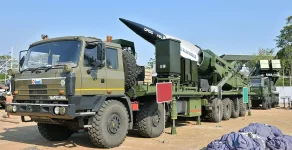
The Defence Research and Development Organisation (DRDO) has confirmed a significant capability leap in India’s indigenous air combat arsenal. The Astra Mk2 beyond-visual-range air-to-air missile (BVRAAM) now boasts a validated strike range of 240 kilometres.

This development was announced by Perina Devi, a senior official at DRDO’s Defence Research and Development Laboratory (DRDL), during an interaction with India TV.

This confirmation marks a critical milestone for the programme. Previous estimates had placed the missile's range in the vicinity of 160 to 200 kilometres. The revised figure of 240 kilometres categorises the Astra Mk2 as a premier long-range interceptor, placing it in an elite league of global weaponry.

Advanced Propulsion Technology​

The core of this performance enhancement is the missile's dual-pulse solid rocket motor.

Unlike traditional single-pulse motors that burn all their propellant in one go, a dual-pulse engine allows for energy management during flight.

It can sustain speed over a longer duration or save a 'pulse' of energy for the final moments of engagement. This ensures that the missile retains high manoeuvrability and a high "kill probability" even against agile fighter jets at extreme ranges.

With this propulsion system, the Astra Mk2 is now broadly comparable to the American AIM-120D AMRAAM and approaches the engagement envelope of the European Meteor missile.

It significantly outperforms the earlier Astra Mk1, which is currently in service with a range of approximately 110 kilometres.

Indigenous Success and Strategic Autonomy​

DRDO has highlighted that the Astra Mk2 features nearly 90 per cent indigenous content.

This high level of self-reliance reduces India's dependence on foreign original equipment manufacturers (OEMs) for critical sub-systems such as seekers and actuators.

The missile’s design includes a flexible pylon configuration that supports both "cold" and "hot" launch mechanisms.

This versatility simplifies the integration process across the Indian Air Force's (IAF) diverse fleet of Russian, French, and indigenous fighter aircraft.

Integration and Induction Timeline​

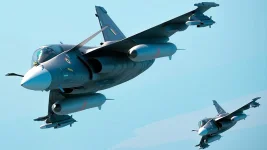
According to Perina Devi, the integration of the Astra Mk2 on the frontline Su-30MKI air superiority fighter is already complete. The focus will now shift to the indigenous Tejas Mk1A Light Combat Aircraft, with integration work scheduled to commence shortly.

Most significantly, the transition from development to active service is imminent. The induction of the Astra Mk2 into the Indian Air Force is expected to begin by the end of this year.

This timeline suggests that Indian pilots will soon have access to a weapon system capable of challenging adversaries well before they can respond.

Strategic Implications​

The extended range of 240 kilometres fundamentally alters the IAF’s aerial engagement doctrine.

It provides Indian fighters with a decisive "stand-off" capability, allowing them to threaten high-value enemy assets—such as Airborne Warning and Control Systems (AWACS) and mid-air refuellers—from safe distances.

In the regional context, this development is seen as a direct counter to long-range missiles like the Chinese PL-15.

By closing the technological gap with global missile powers, the Astra Mk2 ensures that India maintains air dominance in the contested skys of the future.
 
Great development, but you need robust sensor fusion, EW hardened radars, seekers, sensors to use its full potential, so a fleet of 24 anytime operational ELINT aircraft is must to guide the A2A missiles in a conflict, with a secure two way data link it can significantly save costs, no aircraft in our inventory can guide the missile to this long ranges
 
Chinese PL17 is coming. We should be all prepared to face PL17 which has 400km range.
 
We need awacs to take advantage of this. The real choke is the detection and how well integrated they are with other systems
 
Great development, but you need robust sensor fusion, EW hardened radars, seekers, sensors to use its full potential, so a fleet of 24 anytime operational ELINT aircraft is must to guide the A2A missiles in a conflict, with a secure two way data link it can significantly save costs, no aircraft in our inventory can guide the missile to this long ranges
Incidentally ELINT ac do not guide missiles or any other function except gather intel. What you probably meant was AWACS. Even then it is a ridiculous number. If you have even 1/3rd of that number ( 8) air borne at one time, do you even know how many fighters you have to assign to each of them to protect them?? It will leave the IAF doing only that, no OCA. You can't win a war doing DCA missions. You need to fly OCA. An AWACS should only be airborne for specific purposes. IAF is not a resource rich AF like the USAF with overwhelming numbers or budget. Since they need to fight with what they have, your idea will have to wait for some other day.
 
Incidentally ELINT ac do not guide missiles or any other function except gather intel. What you probably meant was AWACS. Even then it is a ridiculous number. If you have even 1/3rd of that number ( 8) air borne at one time, do you even know how many fighters you have to assign to each of them to protect them?? It will leave the IAF doing only that, no OCA. You can't win a war doing DCA missions. You need to fly OCA. An AWACS should only be airborne for specific purposes. IAF is not a resource rich AF like the USAF with overwhelming numbers or budget. Since they need to fight with what they have, your idea will have to wait for some other day.
AWACS are also ELINT platforms dude, and if you don't have that no of AWACS then how will you protect the extensive 7000km border (combining both indo pak and indo china) 18-20 AWACS/AEW&C is must to maintain a 24/7 deterrent along the western and northern borders there's no other option, and yes we don't have overwhelming funds that's why we lack those AWACS and a huge number of other platforms in tri services
 
AWACS are also ELINT platforms dude, and if you don't have that no of AWACS then how will you protect the extensive 7000km border (combining both indo pak and indo china) 18-20 AWACS/AEW&C is must to maintain a 24/7 deterrent along the western and northern borders there's no other option, and yes we don't have overwhelming funds that's why we lack those AWACS and a huge number of other platforms in tri services
Firstly dude use the correct terminology. For your info ELINT is a secondary job for AWACS, not its primary job.

Second they also happen to be awfully expensive platforms. If it were my choice, I would not be stopping at 18-20. Why not 30-36? Plus the nature of our borders in places are such that any number of AWACS would still leave gaps. There are other ways of filling those gaps. That is very much on and the gaps have been minimized. IAF uses its AWACS more optimally, for mission specific tasks. In fact it is a waste of a very valuable resource to use it defensively for airspace surveillance on the border. They must be used for offensive tasks. When they are airborne, that your surveillance task is also being met, is again a secondary outcome just like ELINT. Their primary role must be purely offensive.
 
Firstly dude use the correct terminology. For your info ELINT is a secondary job for AWACS, not its primary job.

Second they also happen to be awfully expensive platforms. If it were my choice, I would not be stopping at 18-20. Why not 30-36? Plus the nature of our borders in places are such that any number of AWACS would still leave gaps. There are other ways of filling those gaps. That is very much on and the gaps have been minimized. IAF uses its AWACS more optimally, for mission specific tasks. In fact it is a waste of a very valuable resource to use it defensively for airspace surveillance on the border. They must be used for offensive tasks. When they are airborne, that your surveillance task is also being met, is again a secondary outcome just like ELINT. Their primary role must be purely offensive.
The primary job of an Airborne Warning and Control System (AWACS) aircraft is to provide long-range, all-weather, 360-degree surveillance, command, control, and communication (C3) capabilities to military forces. Acting as an "eye in the sky," its core function is to detect, identify, and track airborne threats (aircraft and missiles) and, to a lesser extent, surface targets (ships and vehicles), while directing friendly fighters and attack aircraft in real-time. For border airspace surveillance (wartime) Akashteer, trigun, and IACCS are used but for directing weapons to more than 150-200 km you can't do that without AWACS (even our AEW&C can't direct for more than 250-300 km)
 
The primary job of an Airborne Warning and Control System (AWACS) aircraft is to provide long-range, all-weather, 360-degree surveillance, command, control, and communication (C3) capabilities to military forces. Acting as an "eye in the sky," its core function is to detect, identify, and track airborne threats (aircraft and missiles) and, to a lesser extent, surface targets (ships and vehicles), while directing friendly fighters and attack aircraft in real-time. For border airspace surveillance (wartime) Akashteer, trigun, and IACCS are used but for directing weapons to more than 150-200 km you can't do that without AWACS (even our AEW&C can't direct for more than 250-300 km)
Do you know what the abbreviation AWACS stands for. It is Airborne warning and control system. Yes it does surveillance but that is awfully expensive to just get an AWACS airborne only for surveillance. Even the US can't afford that and doesn't do that. They are meant to be used primarily for an offensive function to control and direct large offensive packages. Yes they also pitch in for DCA missions but only when they are airborne for their own job. Nobody gers an AWACS airborne just for surveillance. It would be like using a Rafale for battle field air strike ( a ground forces support role). Yes the Rafale can very much do it but it is an awfully expensive way to do that task. To take to really extreme levels replace the Rafale with an F-22 Raptor. Sure the Raptor will do it as well as any other but look at the cost per hour compared to say the A-10. Also one stray bullet can lose you a Raptor or Rafale. So why use it for something where other options are available.
 
Do you know what the abbreviation AWACS stands for. It is Airborne warning and control system. Yes it does surveillance but that is awfully expensive to just get an AWACS airborne only for surveillance. Even the US can't afford that and doesn't do that. They are meant to be used primarily for an offensive function to control and direct large offensive packages. Yes they also pitch in for DCA missions but only when they are airborne for their own job. Nobody gers an AWACS airborne just for surveillance. It would be like using a Rafale for battle field air strike ( a ground forces support role). Yes the Rafale can very much do it but it is an awfully expensive way to do that task. To take to really extreme levels replace the Rafale with an F-22 Raptor. Sure the Raptor will do it as well as any other but look at the cost per hour compared to say the A-10. Also one stray bullet can lose you a Raptor or Rafale. So why use it for something where other options are available.
Who is saying to use it for only surveillance, my point is that you can't use any missile(>150km range) without a AWACS
 
About your claimed range limitation of less than 150 kms
I said 150-200 km:Su30 mki N011M radars can guide a missile/track a fighter size target for 110-200 km, rafale RBE2 AESA radars can guide a missile/track a fighter size target for 200-250 km , for tejas mk1a their ELTA ELM 2052 radars can guide a missile for fighter size targets for 110-150 km
 
I said 150-200 km:Su30 mki N011M radars can guide a missile/track a fighter size target for 110-200 km, rafale RBE2 AESA radars can guide a missile/track a fighter size target for 200-250 km , for tejas mk1a their ELTA ELM 2052 radars can guide a missile for fighter size targets for 110-150 km
First read your statement again. There was no mention of 200 km.
Second you glibly put out figures of Radars of various fighters. Where do you get your figures from?? IAF has never put them out and they are the only ones who know the actual figures.
 
First read your statement again. There was no mention of 200 km.
Second you glibly put out figures of Radars of various fighters. Where do you get your figures from?? IAF has never put them out and they are the only ones who know the actual figures.
Review #12 comment which mentions 200km, and it's not said glibly , doesn't matters if IAF never put those figures , every figure is public from the manufacturer itself and these are basic GK,
 

Forum statistics

Threads
6,409
Messages
63,037
Members
4,979
Latest member
arnab
Back
Top