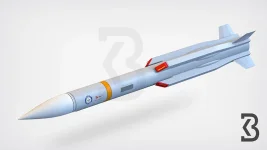
India's Defence Research and Development Organisation (DRDO) is reportedly evaluating a new variant of the Long Range Anti-Ship Missile (LR-AShM) that could strike targets up to 3,500 kilometres away.
This would be a massive upgrade from the current version, which has a proven range of 1,500 kilometres.
By more than doubling its reach, this future weapon would transform from a coastal defence tool into a strategic asset capable of hitting distant naval threats deep in the ocean.
The extended-range model will build upon the LR-AShM’s existing hypersonic boost-glide technology.
Originally designed for the Indian Navy, this system travels at exceptional speeds to destroy targets situated far out at sea.
DRDO has designed the base missile to accurately hit both stationary objects and moving vessels, with the flexibility to carry multiple types of conventional warheads.
Pushing the missile's limits to 3,500 kilometres requires complex engineering rather than simply adding more fuel.
To endure a much longer flight time, scientists will need to completely overhaul the weapon’s rocket motors, physical shape, heat shielding, navigation technology, and overall flight path.
To achieve this distance, engineers may rely on more powerful solid rocket fuel and a highly efficient launch sequence.
The initial rocket stages must propel the glide vehicle to extreme heights and speeds, up to Mach 10, before detaching.
While specific blueprints remain classified, research will likely focus on improving fuel chemistry, engine performance, and the physical staging of the missile.
Once detached, the hypersonic glide vehicle itself becomes the key to reaching distant targets. Instead of flying in a traditional arc like standard missiles, a boost-glide system surfs the upper edges of the atmosphere using aerodynamic lift.
A long-range variant would be programmed with a highly precise flight path, often called a quasi-ballistic or skipping trajectory, to maintain blistering speeds across thousands of kilometres.
Managing extreme heat will be one of the toughest hurdles for the DRDO team. Flying at hypersonic speeds for extended periods generates intense friction, raising temperatures above 2,000°C.
To ensure the missile can still steer effectively during a 3,500-kilometre journey, scientists must develop superior heat-resistant shields, stronger structural materials, and a more streamlined shape.
Accurately guiding the weapon over such vast distances is another major obstacle. Even a tiny calculation error early in the flight could cause the missile to miss its target by miles.
Therefore, the future system will require an incredibly reliable navigation setup, merging onboard sensors with satellite tracking and other independent steering technologies.
To secure this accuracy, India's own NavIC satellite network will likely be integrated into the system.
In scenarios where enemy forces jam or block satellite signals, advanced internal sensors—like ring-laser or fibre-optic gyroscopes—would keep the missile on course. It is critical that the weapon can successfully strike its target even in heavy electronic warfare environments.
The successful development of a 3,500-kilometre missile would dramatically shift regional security dynamics.
It would allow India's armed forces to threaten hostile fleets located far out in the ocean using launchers safely positioned on land.
This capability creates a massive defensive bubble—known as an anti-access/area-denial (A2/AD) zone—protecting the Indian mainland and key island territories from naval threats.
Rather than replacing current weapons like the proven BrahMos supersonic cruise missile, the extended LR-AShM would serve as a powerful companion.
While BrahMos remains highly effective at shorter distances, the hypersonic boost-glide missile provides an ultra-fast, long-range alternative.
This combination makes it exceptionally difficult for adversaries to anticipate or defend against India's naval strikes.
At this stage, the 3,500-kilometre target is an ambitious research goal rather than an official military specification. DRDO has not publicly announced a working model with this expanded reach.
The project will require years of rigorous design work, trials, and testing before such an advanced weapon is ready for active military service.
If realised, this programme would stand as one of India's most significant achievements in long-range missile technology.
It aligns perfectly with the Indian Navy's growing focus on keeping enemy warships far away from national waters and building a formidable, wide-reaching network for maritime defence.