The Indian Navy is on the verge of significantly upgrading its maritime security network as the Vertical Launch Short Range Surface-to-Air Missile (VL-SRSAM) advances into its final stages of preparation before official induction.
Engineered by the Defence Research and Development Organisation (DRDO) and manufactured by Bharat Dynamics Limited (BDL), this state-of-the-art interceptor has proven its reliability over numerous evaluations.
A pivotal benchmark was achieved on March 26, 2025, when a successful test firing took place at the Integrated Test Range (ITR) in Chandipur, Odisha.
In the course of this recent evaluation, the weapon was fired from a land-based vertical platform to intercept a rapidly moving, low-flying aerial target at close proximity.
This flawlessly demonstrated the system's ability to operate effectively near the horizon, a vital defence mechanism designed to neutralise hostile sea-skimming anti-ship missiles that attempt to evade radar detection by flying just above the ocean surface.
Extended Range and Enhanced Capabilities
Originally intended to secure targets within a 40-kilometre radius, the VL-SRSAM has greatly exceeded initial expectations.According to a Parliamentary Standing Committee on Defence report released in early 2026, the weapon now boasts an operational reach of roughly 80 kilometres.
Coupled with an altitude limit of 16 kilometres, this doubled strike envelope allows the Indian Navy to effectively combat a broader array of dangers, including high-flying unmanned aerial vehicles (UAVs) and low-altitude cruise missiles.
Consequently, this extended reach elevates the VL-SRSAM from a standard close-in asset to an intermediate shield, smoothly linking point defence operations with broader area defence strategies.
Key Technical Specifications
- Base Design: Derived from the indigenous Astra Mark 1 beyond-visual-range (BVR) air-to-air missile.
- Speed: Travels at blistering speeds up to Mach 4.5.
- Propulsion: Powered by a single-stage solid propellant motor.
- Guidance: Utilises an active Radio Frequency (RF) seeker and an inertial navigation system with a fiber-optic gyroscope for pinpoint accuracy.
This precise blend of swiftness and flexibility guarantees a formidable strike rate, thoroughly overwhelming advanced enemy munitions that attempt sudden, evasive movements in the final moments of their approach.
360-Degree Multi-Directional Defence
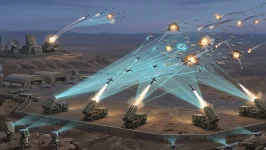
One of the most notable technical advantages of the VL-SRSAM is its vertical firing mechanism, housed in specialised twin quad-pack canisters.This layout permits launches from 360 degrees without the necessity of turning a physical turret toward the target.
This marks a massive leap forward compared to traditional, mechanically rotating launchers that consume precious seconds adjusting their aim.
Consequently, warships can simultaneously fire at multiple threats approaching from entirely different angles.
By eliminating mechanical delays and drastically cutting down response times, the system provides vital protection against overwhelming, multi-directional saturation attacks during intense naval conflicts.
Future Fleet Integration
Looking to the future, this interceptor is designated to serve as the core air-defence battery for the Indian Navy’s anticipated Next-Generation Missile Vessels (NGMVs) as well as the Next-Generation Corvettes (NGCs).Deploying these missiles will establish an impenetrable defensive dome against diverse airborne hazards, ranging from loitering munitions to deadly anti-ship rockets.
In an era where maritime battles are defined by highly coordinated, multi-directional assaults, deploying a rapid-response weapon of this calibre is indispensable.
Ultimately, the VL-SRSAM will function flawlessly within a tiered defensive perimeter, perfectly supporting long-range interceptors on the outer edge and Close-In Weapon Systems (CIWS) as the last line of defence.