New Delhi’s prospect of stepping into the European Future Combat Air System (FCAS) is gathering significant momentum, even as the colossal sixth-generation fighter project grapples with severe internal friction.
Recent signals from German government and political circles indicate that Berlin is generally receptive to India becoming a partner.
However, this openness hinges on France and Germany resolving their deep-seated disagreements over workshare.
This potential expansion of the alliance arrives at a critical juncture, widely viewed by defence experts as a make-or-break moment for the entire European initiative.
The ambitious FCAS programme—spearheaded by France’s Dassault Aviation, Germany’s Airbus Defence and Space, and Spain’s Indra—aims to build a "system of systems."
This concept includes a New Generation Fighter (NGF) connected to a fleet of autonomous "loyal wingman" drones via an advanced combat cloud.
Currently, however, the consortium is bogged down by severe industrial clashes over who leads the development of the core crewed fighter jet.
Dassault, acting as the prime contractor for the NGF, remains in a bitter tug-of-war with Airbus concerning intellectual property rights, design authority, and overall programme leadership.
Dassault has reportedly pushed for up to 80% of the workshare on the fighter, leading its CEO, Eric Trappier, to explicitly warn that the entire project could fall apart if Airbus does not yield.
These mounting tensions have prompted what many consider a final, desperate attempt at mediation to save the three-nation pact as it struggles to transition from its current technology demonstration phase (Phase 1B) into actual prototype construction.
If the partners cannot find common ground, Europe risks the collapse of its most prominent future combat aviation programme, which would send devastating financial and industrial shockwaves across the continent.
In the midst of this European deadlock, India has stepped forward with a formal proposal to join the FCAS initiative.
During the 6th India-France Annual Defence Dialogue hosted in Bengaluru in February 2026, New Delhi made clear its desire to participate in the co-development and co-manufacturing of the system.
According to recent updates from the Indian Defence Ministry, this signals a major shift in India’s military procurement strategy: transitioning from a traditional buyer of foreign hardware to a foundational development partner in cutting-edge global aerospace projects.
Following the February dialogue, India’s Ministry of Defence informed Parliament in March 2026 that the Indian Air Force is actively exploring two distinct international pathways for sixth-generation technology: the European FCAS and the UK-Italy-Japan led Global Combat Air Programme (GCAP), which is developing the Tempest fighter.
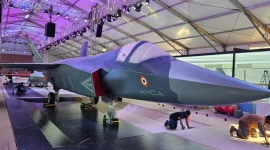
This parallel evaluation is a calculated strategy. By exploring both European consortia while simultaneously funding its own indigenous Advanced Medium Combat Aircraft (AMCA) and Ghatak unmanned combat drone programmes, India is hedging its technological bets.
The goal is to secure access to heavily guarded breakthroughs, such as artificial intelligence sensor fusion, adaptive jet engines, manned-unmanned teaming, and superior stealth capabilities.
Berlin’s reported willingness to welcome India into the fold carries substantial strategic weight.
Germany’s primary hurdles within the FCAS framework have always centred on securing fair technological access and industrial participation.
Bringing India into the consortium—especially if managed under a French-led structure—could inject much-needed financial capital and massive manufacturing scale into the programme, potentially acting as a stabilizing force to calm the turbulent European waters.
However, defence analysts are closely monitoring a more pressing scenario: the potential fracturing of the FCAS alliance.
Should current mediation efforts collapse, France is widely anticipated to trigger a contingency "Plan B."
Under this alternate route, Paris might abandon the trilateral setup in favour of a more streamlined bilateral or minilateral partnership, with India standing out as the ideal candidate.
This would enable France to maintain absolute design leadership over the fighter jet while replacing the financial and industrial backing of Germany with India’s rapidly growing aerospace sector.
A bilateral pivot would be heavily supported by the already deep defence ties between New Delhi and Paris.
The successful procurement and operation of the Dassault Rafale fighter have already established a sprawling ecosystem of joint ventures, supply chains, and technological trust between the two nations.
Utilizing this existing Rafale infrastructure in India could drastically speed up the manufacturing and local production of any future fighter jet born from the FCAS framework.
Ultimately, whether India joins the current three-nation European structure or a newly formed French-led alliance, participating in the FCAS programme offers immense benefits.
It grants the Indian Air Force access to exclusive sixth-generation technologies that are rarely shared on the open market.
Furthermore, collaborating on a global scale would massively benefit India's domestic AMCA project, allowing for the direct transfer of knowledge in critical areas like advanced propulsion, distributed combat networks, and radar-evading stealth design.