- Views: 1K
- Replies: 1
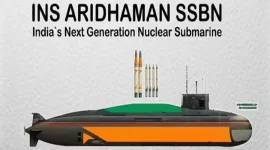
India's ambitious next-generation nuclear submarine initiative, focusing on the advanced S5-class SSBN (Ship Submersible Ballistic Nuclear), is rapidly advancing.
Recent reports indicate that the government may soon approve the simultaneous construction of a second vessel to accompany the lead submarine currently being built.
Despite the intense secrecy surrounding the project, it has reportedly achieved a major breakthrough, as the initial steel-cutting ceremony for the first S5 boat was successfully completed in late 2025.
Defence sources suggest that building these vessels in tandem will greatly accelerate India's naval expansion and operational readiness.
Because of the highly sensitive nature of this strategic defence asset, official details have been kept strictly under wraps.
However, the foundational planning for the S5 initiative actually commenced several years in the past, closely monitored by top government tiers, such as the Prime Minister’s Office.
This extended period of preparation highlights the immense technical hurdles involved in upgrading from the earlier Arihant-class submarines to a significantly larger vessel.
Open-source naval estimates indicate the new S5 class could displace anywhere from 13,500 to as much as 17,000 tonnes, providing a formidable, globally competitive platform for intercontinental strikes.
Fabrication of the S5 fleet is taking place at the Ship Building Centre (SBC) located in Visakhapatnam.
This is the very same shipyard responsible for launching India’s previous SSBNs, namely the INS Arihant, INS Arighaat, and their extended successors.
In order to handle the massive size of the S5-class, a newly constructed, heavy-duty dry dock was made operational in 2025.
This vital infrastructure enhancement will not only accommodate the towering S5 submarines but will also serve the concurrent Project-77, which aims to build 10,000-tonne nuclear-powered attack submarines (SSNs) for the Indian Navy.
A state-of-the-art nuclear propulsion unit serves as the core of the S5’s vast power.
Scientists at the Bhabha Atomic Research Centre (BARC) have successfully engineered a 190 MW pressurised water reactor, which offers a massive boost in energy compared to the 83 MW reactors found in the older Arihant-class.
This tremendous leap in energy generation will enable the S5 to maintain faster travel speeds while submerged for months at a time without the need to refuel.
Additionally, it will easily power demanding modern equipment, such as superior acoustic sensors, pump-jet propulsion, and advanced noise-reduction stealth features.
Furthermore, the vessel is being specifically tailored to carry the powerful K-6 submarine-launched ballistic missile (SLBM).
This three-stage, solid-propellant weapon will grant India a true intercontinental reach from the sea.
Defence analysts note that the K-6 is expected to feature Multiple Independently Targetable Re-entry Vehicle (MIRV) technology and boast an impressive range of 8,000 to 9,000 kilometres.
By equipping the S5 with the K-6, the Indian Navy will be able to securely target distant strategic locations deep within Asia or Europe without ever leaving the protective waters of the Indian Ocean.
Introducing this level of firepower is a monumental upgrade over the existing platforms armed with the shorter-range K-4 missiles.
It firmly establishes a robust and highly secure second-strike nuclear capability for the nation.
By merging ultra-long-range weaponry with exceptional underwater endurance and quiet propulsion, the S5-class will become a cornerstone of India’s defence strategy, ensuring reliable continuous at-sea deterrence amidst a challenging and shifting global security landscape.
The strategic decision to manufacture two S5 submarines at the same time signals a clear intent to rapidly scale up the underwater fleet.
Building these vessels concurrently allows the defence industry to streamline its manufacturing workflows, ultimately lowering the unit cost of each submarine while delivering them much faster.
This twin-building method is a proven technique widely utilised by leading naval powers around the world to maintain industrial momentum.
Current projections suggest India plans to build a total of four to six of these formidable vessels by the late 2030s.
From a broader perspective, the S5 project is the crowning achievement of decades of steady development in India's nuclear maritime sector.
Tracking the journey from the first Arihant-class submarines through to the improved S4 models and finally to the massive S5 reveals a clear and consistent evolution.
It highlights the country's relentless drive to increase the size, destructive power, and technological independence of its naval defence forces.