- Views: 2K
- Replies: 5
India’s ambitious stealth drone project, the Ghatak Unmanned Combat Aerial Vehicle (UCAV), is set to receive a major sensor upgrade.
Spearheaded by the Defence Research and Development Organisation (DRDO), development is rapidly advancing on a specialised Active Electronically Scanned Array (AESA) radar system tailored specifically for the platform.
Designed with Low Probability of Intercept (LPI) technology, this indigenous radar will allow the Ghatak to strike deep into hostile territory, tracking targets seamlessly without giving away its own location through detectable electronic signatures.
AESA Architecture for Unmatched Stealth
Unlike older radar systems that rely on a single, bulky moving transmitter, AESA technology utilises thousands of miniaturised solid-state Transmit/Receive (T/R) modules.This allows the radar to steer its electronic beams almost instantly without any moving mechanical parts.
Crucially for the Ghatak UCAV, this setup permits the radar to transmit across multiple frequencies at once.
By rapidly hopping between these frequencies, the UCAV's radar signals disguise themselves as natural background noise to enemy air defence networks, dramatically enhancing the drone's survivability in highly contested airspace.
The Core Advantage: Low Probability of Intercept (LPI)
At the heart of this new system is its Low Probability of Intercept (LPI) functionality.LPI is vital for stealth aircraft, ensuring that hostile Radar Warning Receivers (RWR) cannot detect the drone's presence.
The Ghatak's radar achieves this through extreme frequency agility—altering its frequency with every single pulse emitted.
Furthermore, it leverages smart power management, transmitting only the absolute minimum amount of energy necessary to lock onto a target.
Harnessing Next-Generation GaN Technology
Taking cues from the successful Uttam AESA radar programme developed by DRDO's Electronics and Radar Development Establishment (LRDE), the Ghatak's radar is expected to be powered by cutting-edge Gallium Nitride (GaN) semiconductor technology.GaN modules represent a generational leap over older Gallium Arsenide (GaAs) components, offering superior thermal efficiency and substantially higher power output.
This means the radar can see further and with greater clarity, all while tightly controlling its emissions to maintain the drone's invisible profile.
Conformal Design for a Low Radar Cross Section
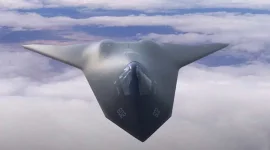
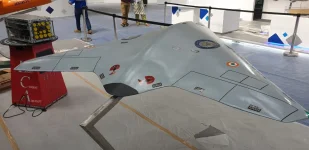
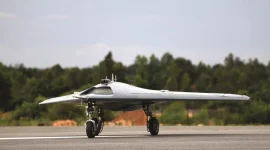
The Ghatak is designed as a tailless flying wing—a shape inherently meant to evade radar.To preserve this highly aerodynamic and stealthy profile, the new AESA antenna will be conformally integrated.
This means the radar will be built flush into the UCAV's skin and airframe, rather than housed in a traditional protruding nose cone or radome.
By eliminating external bulges that bounce enemy signals back, the conformal placement guarantees that the UCAV maintains an exceptionally low Radar Cross Section (RCS).
An Integrated, Autonomous Sensor Network
This radar is not a standalone piece of equipment; it acts as the primary node in a highly sophisticated sensor suite.A standout feature will be its Synthetic Aperture Radar (SAR) mode, granting the drone the ability to map ground targets in extremely high resolution, even through thick clouds, smoke, or the dead of night.
Additionally, the system features a passive "receive-only" mode. When activated, the radar stops emitting entirely, instead acting as a listening device to silently detect enemy jamming attempts and hostile electromagnetic activity.
Sensor Fusion Shaping Future Combat
To achieve true autonomy, the Ghatak will rely on advanced sensor fusion.Data gathered by the AESA radar will be instantly combined with the drone's Electronic Warfare (EW) suite and Electro-Optical/Infra-Red (EO/IR) targeting cameras.
By stitching together these distinct data streams, the UCAV's onboard computers will independently identify, classify, and track threats in real-time.
The integration of this domestically produced, LPI-capable AESA radar is a monumental milestone for India’s unmanned combat initiatives.
By marrying advanced stealth designs with world-class, indigenous sensor technology, India is positioning itself to deploy autonomous platforms capable of dominating the future of aerial combat.