Recent indications that the Indian Army might revive its plans to acquire the South Korean K30 Biho—a self-propelled twin 30mm anti-aircraft gun (SPAAG)—have sparked new conversations.
Defence analysts are now debating whether India could build its own equivalent system by utilising the indigenous Zorawar light tank chassis.
Technically, creating a homegrown SPAAG on the Zorawar platform is highly possible. However, defence specialists warn against treating it as a simple swap of equipment.
Transforming the light tank into a dedicated air defence guardian would demand the creation of a brand-new vehicle variant, complete with extensive structural, electrical, and electronic re-engineering.
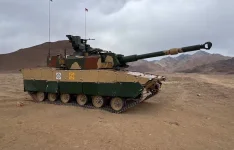
Designed collaboratively by the Defence Research and Development Organisation (DRDO) and Larsen & Toubro, the Zorawar is an advanced 25-tonne light tank built expressly for the challenging high-altitude terrains of India's northern borders.
Powered by a high-output engine (currently utilising a 760 hp Cummins unit, with an indigenous alternative in development) and an advanced suspension setup, it offers exceptional mobility where heavier traditional tanks struggle.
Because of this outstanding agility, the Zorawar chassis is a very appealing candidate for other battlefield tasks, particularly as a highly mobile air defence unit for frontline troops.
Despite this potential, a modern anti-aircraft system has operational demands that vastly differ from those of a standard light tank.
For instance, the South Korean K30 Biho—often called the "Flying Tiger"—is much more than an armoured carrier with two 30mm guns.
Its turret is packed with advanced technologies, including target-tracking radars, electro-optical sensors, complex fire-control computers, and automated ammunition feeders.
Open-source data also indicates the Biho integrates KP-SAM Chiron surface-to-air missiles for extended reach.
All of this equipment brings immense weight and requires tremendous power.
Simply dropping a similarly heavy and complex turret onto the current Zorawar frame would likely push the tank beyond its designed structural limits.
To overcome this, designers would have to engineer a specialized air defence model.
This variant would need a significantly reinforced hull and a stronger turret ring to handle the extra weight and absorb the immense vibrations caused by continuous, high-speed cannon fire.
Additionally, the internal power systems of the vehicle would need a major overhaul.
Modern anti-aircraft vehicles require a massive amount of electricity to keep their radars, tracking optics, and communication arrays running continuously.
A Zorawar-based SPAAG would almost certainly need a built-in Auxiliary Power Unit (APU).
This would allow the air defence systems to function without running the tank's main engine, saving fuel and drastically reducing the vehicle's heat and noise footprint while on watch.
Fortunately, India already holds the technological know-how required to build such an advanced system at home.
The domestic defence sector has a proven track record of creating sophisticated battlefield radars, electro-optical tracking sights, indigenous fire-control software, and Remote Controlled Weapon Stations.
With coordination between the DRDO and private defence firms, these individual technologies could be merged into a single, modular air defence turret designed perfectly for the Zorawar body.
A crucial feature of this system would be "sensor fusion"—the ability to combine data from different tracking tools.
Similar to the K30 Biho, an Indian SPAAG would rely on a pulse-Doppler radar to spot targets from afar, backed up by thermal imaging and electro-optical cameras for precise aiming.
By blending these sensors, the vehicle could maintain a clear picture of the sky even during bad weather or if the enemy attempts to jam its radar signals.
One specific area where a Zorawar-based anti-aircraft system would excel is in fighting off enemy drones.
Today's conflicts highlight the severe danger of cheap drones and loitering munitions.
With the Indian Army currently focusing heavily on Artificial Intelligence and Manned-Unmanned Teaming (MUM-T) in its modernisation drives, an AI-powered Zorawar SPAAG could be revolutionary.
Equipped with automated threat recognition, it would serve as a highly mobile shield, defending tank columns and mountain bases from sudden drone swarms.
Even with these benefits, several hurdles stand in the way.
The Zorawar is a highly advanced and costly piece of machinery. Using such a premium chassis exclusively for short-range air defence might be seen as unnecessarily expensive, especially when standard armoured trucks or wheeled platforms can often do the same job for a fraction of the cost.
Finally, the Indian military is already building a multi-layered air defence shield, which includes massive systems like the S-400 and the upcoming Project Kusha, alongside various medium-range missiles.
Before moving forward, military planners would need to clearly define exactly how an expensive, Zorawar-based SPAAG fits into this wider, integrated defence network.