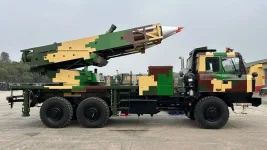
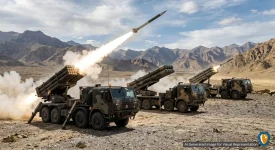
In a major leap forward for the nation's self-reliance in advanced military technology, domestic defence manufacturer SMPP has officially handed over 100 Jet-Based Peacekeeper (Agniveg) kamikaze drones, alongside six training units, to the Indian Army.
This swift procurement highlights India's expanding capabilities in unmanned warfare and reinforces the military's commitment to modernising its deep-strike arsenal with indigenous solutions.
The entire delivery process was executed in a remarkably short span of six months following a series of rigorous user trials.
During these evaluations, the Agniveg system showcased exceptional accuracy, achieving a Circular Error Probable (CEP) of less than five metres.
It also successfully verified its operational reach of roughly 180 kilometres.
Most notably, the drone proved its resilience by maintaining its flight path and targeting accuracy in environments actively disrupted by hostile electronic warfare, including heavy signal jamming and spoofing.
Classified as a loitering munition, the Agniveg utilizes a turbojet engine specifically engineered for one-way suicide missions against high-priority targets located deep within hostile territory.
By blending extended range, automated navigation, and rapid flight speeds, the platform supplies battlefield commanders with a highly adaptable and budget-friendly weapon.
It allows the military to immediately engage critical, time-sensitive targets without putting manned aircraft or ground personnel in danger.
Reaching top speeds of 450 kilometres per hour, the unmanned aircraft is built to autonomously execute precision strikes against a broad spectrum of strategic assets.
These include enemy command and control centres, radar stations, logistics hubs, and other essential infrastructure.
Because the drone is heavily shielded against modern electronic countermeasures, it remains a highly dependable asset on today's technologically contested battlefields.
The integration of the Agniveg system into the armed forces underscores a broader shift in modern combat strategy, where relatively inexpensive, precision-guided drones can achieve destructive results once reserved for costly fighter jets or strategic missiles.
According to Ashish Kansal, CEO and Director of SMPP, the rapid deployment of these drones acts as a critical force multiplier for the military.
Furthermore, open-source intelligence and defence reports indicate that the Agniveg's core design shares technological roots with the Belarusian 'Mirotvorets' drone, reflecting an effective integration of foreign technology transfers with domestic defence manufacturing.
Building on the success of this delivery, SMPP has already proposed a heavily upgraded variant with an extended operational range to further close the capability gap between standard artillery and long-range ballistic missiles.