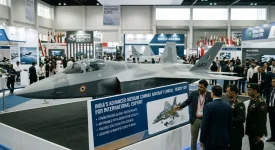
Following the brief but highly impactful Operation Sindoor in May 2025, India has launched a massive and rapid overhaul of its armed forces.
This transformation spans across all military branches, focusing on acquiring advanced drones, hypersonic weapons, integrated air defence networks, and expanding naval power to prepare for complex, multi-domain conflicts.
Shortly after the short-lived confrontation with Pakistan, the Defence Acquisition Council (DAC) fast-tracked massive military purchases.
By July 2025, the government had cleared projects worth approximately ₹1.05 lakh crore. These purchases included advanced surface-to-air missiles, autonomous underwater vehicles (AUVs), electronic warfare (EW) equipment, and mine-countermeasure ships for the Navy.
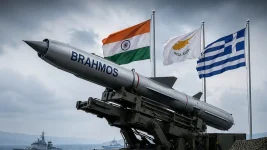
A subsequent approval in August 2025 allocated another ₹67,000 crore for Medium-Altitude Long-Endurance (MALE) drones, upgrades to the Israeli-origin SPYDER air-defence system, and new launchers and fire-control systems for the supersonic BrahMos cruise missile.
Beyond buying new equipment, the Indian Army is fundamentally changing how it organizes and fights on the ground.
To push modern technology directly to frontline troops, hundreds of infantry battalions have been equipped with dedicated "Ashni" drone platoons for localized surveillance and aerial strikes.
Furthermore, the Army has created highly specialized units—such as Rudra Brigades, Bhairav Battalions, Shaktibaan Regiments, Divyastra Batteries, and dedicated Electronic Warfare Brigades. These new formations are designed to integrate traditional combat with digital and electronic warfare.
India’s domestic defence research agency, DRDO, has also hit critical milestones.
On May 7, 2026, DRDO and the Indian Air Force successfully tested the Tactical Advanced Range Augmentation (TARA) system. This indigenous range-extension glide kit transforms standard warheads into highly accurate, long-range guided bombs.
Simultaneously, the country is rapidly advancing its hypersonic missile capabilities. Following a successful November 2024 test of a hypersonic vehicle with a range over 1,500 kilometres, DRDO publicly displayed a new Long Range Anti-Ship Hypersonic Missile during the Republic Day parade in January 2026, signaling a leap in high-speed maritime strike technology.
To protect against complex aerial threats, India successfully tested a new Integrated Air Defence Weapon System (IADWS) in August 2025. This layered shield combines Quick Reaction Surface-to-Air Missiles (QRSAM), portable VSHORADS systems, and next-generation high-power laser weapons.
During the test, the system successfully destroyed three different targets at varying altitudes at once, proving its ability to defeat "saturation attacks" where an enemy uses swarms of drones and cruise missiles simultaneously.
This physical defence shield is managed by advanced software networks like the Integrated Air Command and Control System (IACCS) and the Army's homegrown "Akashteer" system, developed by Bharat Electronics Limited (BEL).
These networks use artificial intelligence to quickly evaluate incoming threats, fuse sensor data, and instantly assign targets.
On the strategic front, India test-fired the Agni-V intercontinental ballistic missile (ICBM) in August 2025, further cementing its nuclear deterrence capabilities.
Maritime strength also saw a major boost with the commissioning of INS Aridaman in April 2026. As India’s third domestically built nuclear-powered ballistic missile submarine (SSBN), it solidifies the nation's guaranteed second-strike capability from the sea.
In one of the largest single modernizations pushes, authorities cleared ₹2.38 lakh crore in March 2026. A major portion of this is aimed at acquiring 114 multi-role Rafale fighter jets under the "Make in India" initiative.
Armed with advanced Meteor air-to-air missiles and Scalp cruise missiles, these aircraft will drastically improve India’s ability to strike deep inside enemy territory.
Ultimately, the rapid military build-up after Operation Sindoor shows India's commitment to adapting to modern warfare. Rather than relying on a single piece of hardware, the military is building a highly connected network of traditional, autonomous, and directed-energy weapons.
This comprehensive modernization aims to secure a strong strategic advantage against Pakistan while ensuring India is fully prepared for broader regional security challenges in the decades to come.