When discussing the historical delays in India’s Kaveri jet engine project, critics typically point to a lack of funding, changing military requirements, or design flaws. However, they rarely mention a critical missing element: the industrial furnace.
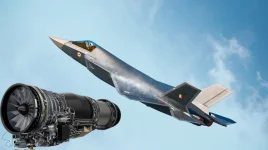
The real hurdle in building a fully indigenous fighter engine has been a lack of advanced metallurgy, rather than just aerodynamics. The core of a jet turbine operates at temperatures exceeding 1,500°C, which would melt ordinary steel or standard titanium.
Manufacturing parts that can withstand such extreme heat requires highly specialised techniques like vacuum remelting, single-crystal casting, and Hot Isostatic Pressing.
Until recently, private companies in India completely lacked these capabilities. Over the last three years, a foundry based in Lucknow has built these very facilities from the ground up.
Today, the same high-tech furnaces producing components for commercial aviation giants like Airbus and Safran are emerging as a vital asset for India's strategic defence goals.
The Global Shift in Aerospace Foundries
For over 60 years, the ability to cast aerospace-grade titanium and advanced superalloys was controlled by a select few global players.Western aviation companies historically relied heavily on Russia's state-backed VSMPO-AVISMA for their structural titanium needs.
This dynamic shifted dramatically after 2022. Major manufacturers such as Airbus, Boeing, Safran, and Rolls-Royce suddenly needed to find and certify new foundries with advanced vacuum melting capabilities outside of Russia, and they needed to do so on tight deadlines.
India faced a similar challenge decades ago during the Kaveri programme.
While the Gas Turbine Research Establishment (GTRE) could design a jet turbine, the country lacked the domestic foundries to produce the necessary heat-resistant single-crystal turbine blades.
Relying on foreign casting facilities proved highly undependable for a nation with little bargaining power at the time.
Aerolloy's Advanced Lucknow Facility
To bridge this gap, Aerolloy Technologies—a subsidiary of PTC Industries—has established a comprehensive manufacturing base in Lucknow, located within the Uttar Pradesh Defence Industrial Corridor.The company has created an integrated production model that handles everything from raw titanium processing to investment casting and final inspection.
The facility features advanced vacuum remelting furnaces and the capability to cast single-crystal and directionally-solidified turbine blades—a rare combination globally and the first of its kind in India.
This complete, single-site setup has caught the attention of international aerospace firms looking to move their supply chains away from Russia and China.
The company has already secured significant agreements, including manufacturing titanium structural castings for Airbus commercial jets, a long-term contract with Safran for civil engine parts, and another agreement for Dassault Aviation's Rafale jets.
Notably, Aerolloy also holds a separate, dedicated memorandum of understanding with Safran specifically for military propulsion components.
Connecting with the AMCA Engine Project
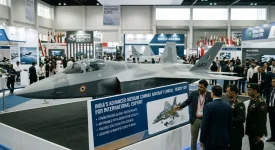
While these developments are promising, it is important not to jump to conclusions regarding India’s upcoming Advanced Medium Combat Aircraft (AMCA).Separately, India is negotiating a major joint venture between the Defence Research and Development Organisation (DRDO) and France's Safran to co-develop a new turbofan engine.
This engine is expected to be in the 110–130 kN thrust class and will feature an entirely new core rather than adapting older designs.
The proposal was reviewed by the Cabinet Committee on Security in August 2026.
While state-owned Hindustan Aeronautics Limited (HAL) is slated as the primary manufacturing partner for the engine's final assembly, Aerolloy does not yet have an official, publicly disclosed role in this specific project.
However, the private foundry’s proven ability to meet strict aerospace standards makes it a strong candidate to support future GTRE-Safran supply chains.
Until official announcements are made, any claims that the private company is directly "supplying the AMCA engine" remain premature.
The Underlying Titanium Sponge Bottleneck
Despite these manufacturing advancements, a deeper foundational issue remains: the shortage of raw materials.All domestic aerospace casting relies on titanium sponge, and India currently has only one producer—Kerala Minerals and Metals Limited (KMML).
Using technology developed by the Defence Metallurgical Research Laboratory, KMML’s production capacity has been firmly capped at just 500 tonnes per year since 2011.
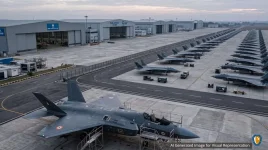
Every downstream defence project—from advanced alloy processing at Mishra Dhatu Nigam (MIDHANI) to HAL’s production line building 24 Tejas Mk1A fighters a year—is constrained by this single raw material bottleneck.
Consequently, India is forced to import the remainder of its aerospace-grade titanium sponge from countries like Japan, China, and Russia.
Even the most advanced private foundry cannot manufacture parts without the necessary raw material, making the expansion of domestic titanium sponge capacity a critical, unresolved limit on the entire industry.
Market Reaction and Valuation
Investors have keenly taken note of PTC Industries' unique market position. In the first quarter of the 2026-2027 financial year, the company reported a massive 466% year-on-year increase in net profit, reaching ₹29.2 crore on revenues of ₹191.8 crore, driven largely by Aerolloy’s strong performance.The stock market has rewarded this growth alongside a broader surge in defence-linked equities, pushing the company's market capitalisation to over ₹31,000 crore by late August 2026.
The market is essentially valuing the company as a near-monopoly proxy for India’s private aerospace materials sector, betting heavily on its long-term potential rather than just its current earnings.
Lessons from France’s Engine Strategy
India’s current trajectory closely mirrors the path France took sixty years ago.When France sought to develop its own independent military jet engines without relying on American oversight, the French government heavily invested in the foundational metallurgy and foundry capabilities of Snecma.
By mastering the unglamorous work of vacuum melting and single-crystal casting for commercial purposes first, France built the industrial base necessary to later produce the successful M53 and M88 engines that power the Mirage and Rafale fighters.
The key lesson is that a sovereign engine capability must be built from the ground up, starting with raw materials and foundries, long before the military actually issues the final requirement.
India has painfully learned this exact lesson through the long delays of the Kaveri project.
While it remains unconfirmed if Aerolloy will be directly embedded in the AMCA engine's supply chain, the broader capability question has been decisively answered.
India’s private sector now possesses the proven ability to cast aerospace-grade metals at scale, validated by major commercial contracts with Airbus and Safran.
True self-reliance in defence aviation does not arrive in a single contract announcement; it is achieved when the necessary industrial furnaces are already operational and running when the nation calls upon them.