- Views: 2K
- Replies: 4
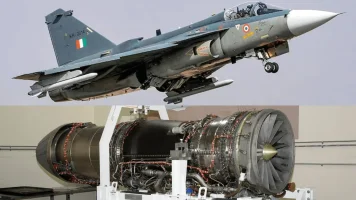
The Indian Air Force (IAF) is actively evaluating the German-manufactured Taurus KEPD 350E cruise missile as a primary deep-strike weapon for its indigenous Tejas fighter fleet.
This development follows the operational lessons learned during the intense border conflict in May last year, often referred to in defence circles as Operation Sindoor, where long-range precision strikes proved decisive.
While the French-origin SCALP-EG missile delivered exceptional combat results during the May operations, its utility is currently restricted by the limited number of launch platforms.
At present, the SCALP-EG is integrated exclusively with the IAF’s 36 Rafale jets.
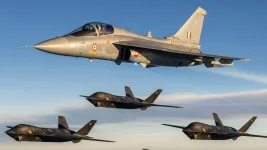
Defence planners are now seeking to democratise this capability across a wider array of aircraft, specifically the Tejas Mk1A and the upcoming Tejas Mk2, to ensure mass and flexibility in future engagements.
German Offer and Technical Edge
Defence sources indicate that Germany has strongly pitched the Taurus KEPD 350E to India, marketing it as a highly capable yet cost-effective complement to the SCALP system.Although both missiles fall into the category of stealthy, air-launched cruise missiles designed to neutralise high-value assets within heavily defended airspace, the Taurus brings a unique technological philosophy to the table.
Developed jointly by Germany and Sweden, the Taurus KEPD 350E is distinguished by its "MEPHISTO" warhead system.
Unlike standard penetrators, this warhead features an intelligent "layer-counting" fuze. This technology allows the missile to sense voids and material density changes as it punches through a structure.
It can be programmed to ignore upper floors and detonate only upon reaching a specific depth, such as a second-level basement.
This makes it uniquely potent against complex, multi-storey underground bunkers, hardened command centres, and reinforced infrastructure like bridges.
In terms of flight performance, the Taurus is engineered for extreme low-level terrain-hugging profiles, allowing it to stay under enemy radar horizons for extended durations.
It is already operational on the Eurofighter Typhoon, Panavia Tornado, and South Korea’s F-15K Slam Eagle, suggesting it is adaptable to different airframes.
The Cost Factor
A significant driver behind the IAF's interest is fiscal prudence. While the SCALP-EG is widely considered the "gold standard" for general deep-strike missions, its high cost makes widespread fleet integration expensive.According to defence insiders, the unit cost of a Taurus missile is estimated between $1.1 million and $1.5 million (approx. ₹9–12 crore).
In contrast, the SCALP-EG (also known as Storm Shadow) commands a price tag estimated between $2.2 million and $2.5 million (approx. ₹18–21 crore).
For the IAF, which aims to equip the growing fleet of Tejas Mk1A and Mk2 jets with a standoff capability, the lower price point of the Taurus could allow for the procurement of a significantly larger stockpile of munitions for the same budget.
Strategic Implications
The potential acquisition of the Taurus KEPD 350E would signal a shift in the IAF’s strike doctrine, moving away from relying on a small, elite fleet for deep strikes to a more distributed model.By arming the indigenous Tejas fighters with a 500-km+ range bunker-busting missile, India would drastically expand its offensive reach.
If the deal proceeds, the Taurus KEPD 350E would provide the IAF with a specialized tool for targeting the most hardened enemy structures, while the SCALP-EG continues its role as a premier general-purpose precision strike weapon.
The move aligns with the IAF's broader push to diversify its weapons inventory and reduce per-mission costs without compromising on lethality.