The Indian Air Force (IAF) is charting a major shift in aerial warfare by seeking to transform its conventional transport aircraft and helicopter fleets into formidable offensive platforms.
By integrating advanced stand-off missiles, air-launched drones, and long-range loitering munitions, the IAF aims to strike enemy targets from safe distances without exposing aircrews to dense hostile air defence networks.
Arming the Rotary Fleet with NLOS Weapons and Drones
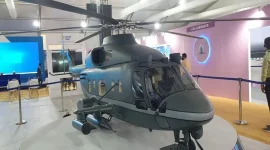
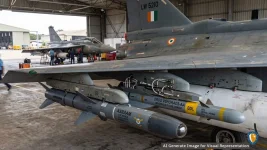
At the forefront of this initiative is a push for a new generation of Non-Line-of-Sight (NLOS) guided ammunition tailored for helicopters.The IAF is looking for lightweight and affordable missile systems capable of neutralising both armoured and soft targets at a range of 50 to 60 kilometres.
A critical requirement for this system is a real-time video feed and a "man-in-the-loop" control mechanism. This advanced feature ensures that the weapon does not just rely on pre-programmed coordinates.
Instead, the crew can physically see the approaching target and manually alter the aim point, or completely cancel the attack during flight. This precision is especially vital when operating in populated areas or tracking fast-moving mobile targets where ground realities change in seconds.
Alongside guided missiles, the IAF is advancing a requirement for drones designed to be deployed directly from helicopters in mid-air.
With an expected range of 80 kilometres and the capacity to carry a minimum 500-gram warhead, these air-launched drones will provide chopper crews with a new method to conduct surveillance, scout enemy positions, and execute precision strikes without ever flying directly over the target area.
Turning Transports into "Arsenal Ships"
Perhaps the most ambitious aspect of the IAF's modernization plan is the transformation of its heavy-lift transport aircraft fleet.Traditionally relegated to moving troops, supplies, and heavy machinery, these large aircraft could soon act as aerial launchpads for long-range unmanned weapons.
The IAF has issued a Request for Information (RFI) for air-dropped loitering munitions compatible with transport planes.
The required specifications are highly lethal: the munitions must be able to hit targets up to 500 kilometres away, carry a 30 kg warhead, and cruise at speeds between 350 and 400 kilometres per hour.
This capability would fundamentally change the role of India's transport aircraft, allowing them to release large numbers of unmanned weapons from friendly airspace to strike heavily defended areas.
Strategic Context: Easing the Burden on Fighter Jets
This tactical pivot brings massive strategic benefits. Currently, the IAF is managing an ongoing shortfall in its fighter jet squadrons.By distributing strike, reconnaissance, decoy operations, and electronic warfare responsibilities across the helicopter and transport fleets, the IAF can free up its limited frontline fighter aircraft for the most critical missions.
The IAF’s initiative closely mirrors modern global military trends.
Similar unmanned networking concepts are actively being tested by the United States under its 'Air Launched Effects' and 'Gremlins' programmes, as well as by Israel, which has successfully integrated modular loitering munitions onto utility helicopters.
As aerial warfare rapidly evolves, the integration of air-launched drone swarms will ensure the IAF maintains a highly flexible and overwhelming strike capability against any adversary.