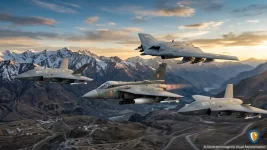
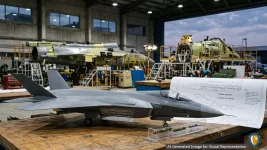
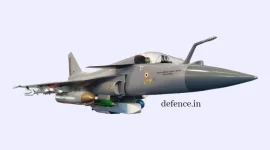
An innovative concept is emerging for the Indian Air Force (IAF) to significantly enhance its air-to-air combat capabilities: deploying powered, unmanned missile carrier drones from manned fighter jets.
This strategy involves launching an unmanned flight platform (UFP) from a deep penetration fighter like the Su-30MKI.
Instead of the fighter directly firing a Beyond Visual Range Air-to-Air Missile (BVRAAM), the drone carries the missile into high-risk airspace and fires it at the target, keeping the pilot and the manned aircraft safely outside the enemy's threat zone.
The Mechanics of the Missile Carrier Concept
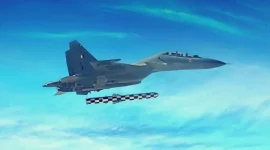
The concept relies on the Su-30MKI’s ability to carry exceptionally heavy payloads.Currently, the fighter is capable of hauling the 2.5-tonne BrahMos-A cruise missile on a specially reinforced centreline pylon. A missile carrier drone of a similar weight class could be mounted in its place.
Once released from the Su-30MKI, this drone—equipped with its own jet engine, navigation systems, and secure datalinks—would fly forward into the contested engagement zone.
Upon reaching the optimal launch point, the drone would fire its payload of BVRAAMs, such as the indigenous Astra Mk2, at hostile aircraft.
By operating as an airborne ammunition magazine, the carrier provides the missile with a vastly improved launch geometry. Firing a 160-200 km range Astra Mk2 from a forward position gives the missile higher kinematic energy in its terminal phase.
This makes it highly lethal against high-value airborne assets like enemy Airborne Warning and Control System (AWACS) aircraft, mid-air refuelling tankers, and heavily defended fighter formations.
Network-Centric Combat
This two-stage engagement model relies heavily on modern network-centric warfare.The carrier drone would not require a bulky, fighter-class radar. Instead, it would receive real-time targeting updates via secure datalinks from an AWACS aircraft, the launching Su-30MKI, or other networked battlefield sensors.
The AWACS provides the initial target track, while the drone flies to the intercept point and relies on the missile's own seeker for the final phase of the attack.
Globally, similar doctrines are gaining traction. The most notable open-source equivalent is the United States DARPA "LongShot" program, which is actively developing an air-launched unmanned combat aerial vehicle capable of employing standard air-to-air weapons to exponentially extend engagement ranges.
Engineering and Survivability Challenges
While the concept provides immense stand-off combat potential, it presents significant engineering hurdles.A 2.5-tonne external payload allowance must accommodate the drone's entire airframe, jet engine, fuel, flight control systems, and electronic systems. This leaves only a fraction of that weight budget for the actual BVRAAMs, limiting the amount of firepower the drone can carry.
Furthermore, survivability is a critical concern. A powered drone entering hostile airspace will be immediately targeted by enemy air defence systems.
To be successful, the carrier would require a highly agile, low-observable (stealth) design integrated with robust electronic warfare protection to survive long enough to release its weapons.
If successfully developed, this system would allow the IAF to drastically shift the point of missile launch closer to the enemy without needing to continuously expand the raw range of the missiles themselves, ultimately ensuring the safety of its frontline manned fighter fleet.