- Views: 2K
- Replies: 2
Speaking at the National Defence Industries Conclave (NDIC) 2026, Jasbir Singh from Hindustan Aeronautics Limited (HAL) shared crucial updates on India’s leap into next-generation aerial warfare.
The focal point of the presentation was the Combat Air Teaming System (CATS) Warrior, an advanced unmanned combat aerial vehicle (UCAV).
Designed to fly alongside human-piloted fighter jets as a "loyal wingman," this 2.2-ton stealth drone has drawn significant interest, with the Indian Air Force (IAF) projecting a major future demand for the platform.
A Force Multiplier with Advanced Capabilities
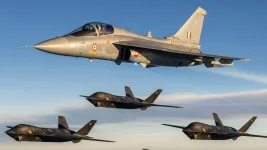
The CATS Warrior is engineered to act as a massive combat multiplier.It will seamlessly integrate with frontline mothership aircraft like the LCA Tejas, Su-30MKI, Jaguar, and the upcoming Advanced Medium Combat Aircraft (AMCA).
Operating either semi-autonomously or under remote guidance, the drone is built to enter highly dangerous airspace to protect human pilots.
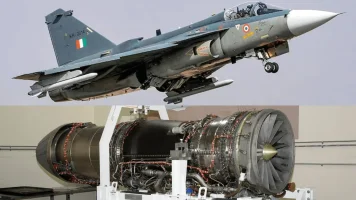
Recent technical data reveals that the 9.1-metre-long drone is powered by twin modified HAL PTAE-W turbofan engines. It boasts a cruise speed of Mach 0.6 (with capabilities to reach Mach 0.9), an operational ceiling of 9,000 metres, and a combat radius of 350 kilometres.
Furthermore, its internal and external hardpoints can carry up to 650 kilogrammes of payload, including DRDO’s Smart Anti-Airfield Weapons (SAAW) and next-generation close-combat missiles.
Swarm Tactics and Tactical Advantages
The scale of the IAF’s vision was underlined by a projected requirement of nearly 100 CATS Warrior units.This number supports a revolutionary tactical approach where a single manned fighter could command a formation of three to four drone wingmen.
These drones are designed to overwhelm enemy radar systems, conduct the suppression of enemy air defences (SEAD), and execute high-risk precision bombings.
Notably, the Warrior can also act as a carrier itself, capable of launching a swarm of up to 24 ALFA-S loitering munitions deep inside hostile territory, or even perform sacrificial "kamikaze" strikes to ensure the survival of the manned mothership.
Cost-Effective Mass Production
Preparing for this large-scale deployment, HAL is actively building a robust supply chain by partnering with private sector startups like NewSpace Research and Technologies. Financial viability is a major advantage of the programme.With an estimated price tag of $5 million to $10 million per unit, the CATS Warrior costs only a fraction of a traditional manned fighter jet.
This affordability allows the military to field them in large numbers without exhausting defence budgets.
Its radar-absorbent materials, low-observable shaping, and internal weapon bays make it a highly survivable asset for modern combat.
Timeline and Naval Potential
The programme is advancing rapidly through its developmental stages.Following successful engine ground runs and system integrations, the CATS Warrior is firmly on track for its first flights between 2026 and 2027.
By relying on indigenous design, including locally developed mission computers and algorithms, India is ensuring complete technological sovereignty over the system.
Looking ahead, HAL is also exploring adapted, smaller variants of the Warrior capable of operating from aircraft carriers, which would bring this manned-unmanned teaming revolution to the Indian Navy.